


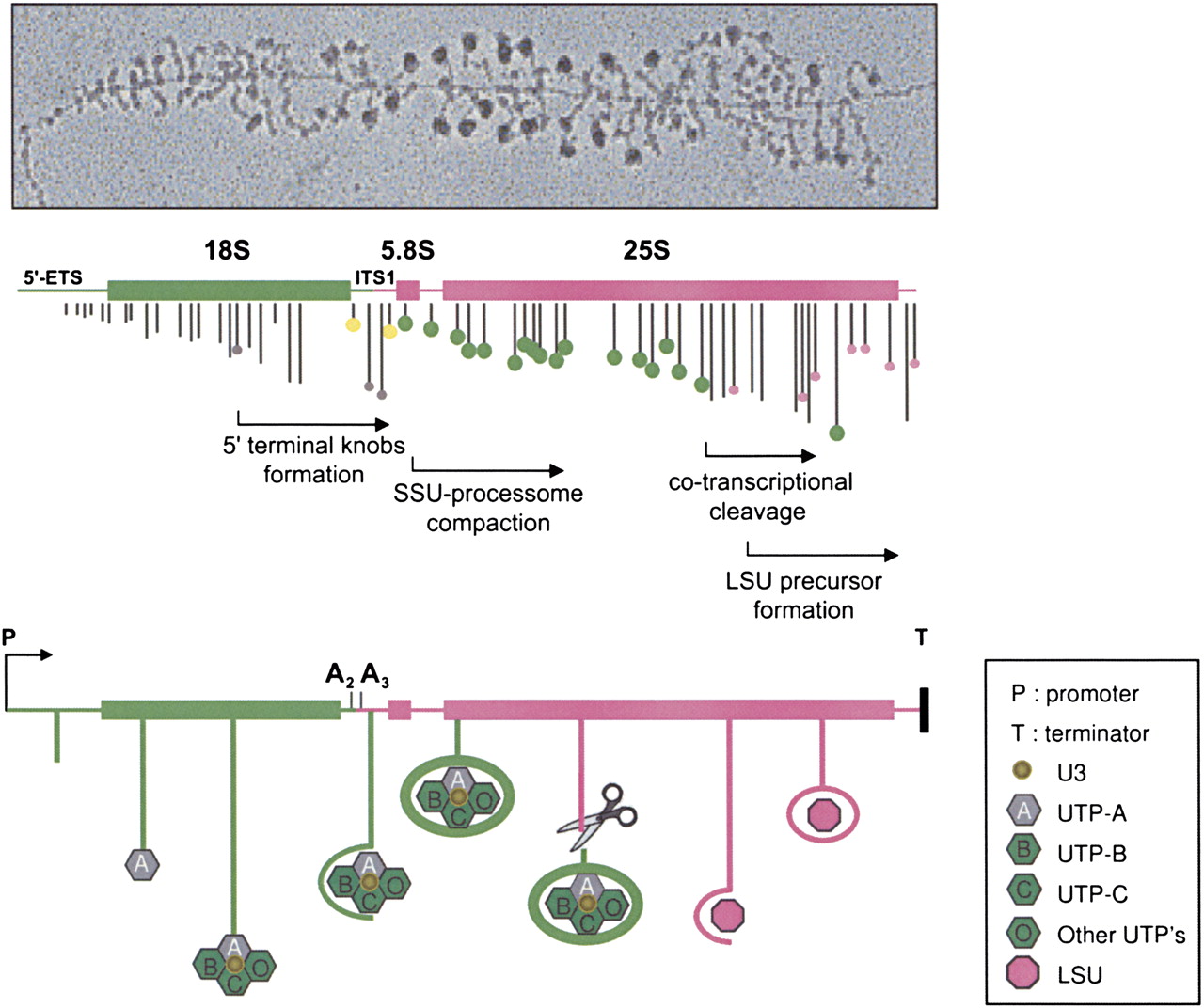
SSU-processome assembly pathway. (Upper panel) EM visualization of an actively transcribed rDNA gene by chromatin spread (courtesy of Ann Beyer and Yvonne Osheim, University of Virginia). (Middle panel) Interpretative tracing and transcript mapping (redrawn from Osheim et al. 2004). rDNA is color-coded as follows: 5′-end to center of ITS1 in green; center of ITS1 to the 3′-end in pink. Particles that appear on the transcripts are shown on the tracing as follows: gray particles correspond to the initial small 5′-terminal knobs, yellow to the newly formed (loose) large SSU-processomes, green to the mature (tight) SSU-processomes, and pink to pre-large-subunit knobs that form at the 5′-end of cleaved transcripts. (Lower panel) SSU-processome assembly starts with the binding of the UTP-A subcomplex to nascent transcripts generating a 35S•UTP-A intermediate. This is a prerequisite step that impinges on the recruitment and assembly of several other UTP subcomplexes (UTP-B, UTP-C, and UTP-O). Utps that do not belong to either of the UTP-A, UTP-B, or UTP-C subcomplexes are here tentatively referred to as UTP-O, for Others. The SSU-processome condenses and comes in close proximity to the 5′ end of the 25S gene. This correlates with the strongest Ch-IP interaction at amplicon 11. In a currently estimated 50% of the cases, this is followed by cotranscriptional cleavage within ITS1, pre-40S subunits release, and large subunit rRNP assembly. Key to the right. (LSU) Large subunit.




