


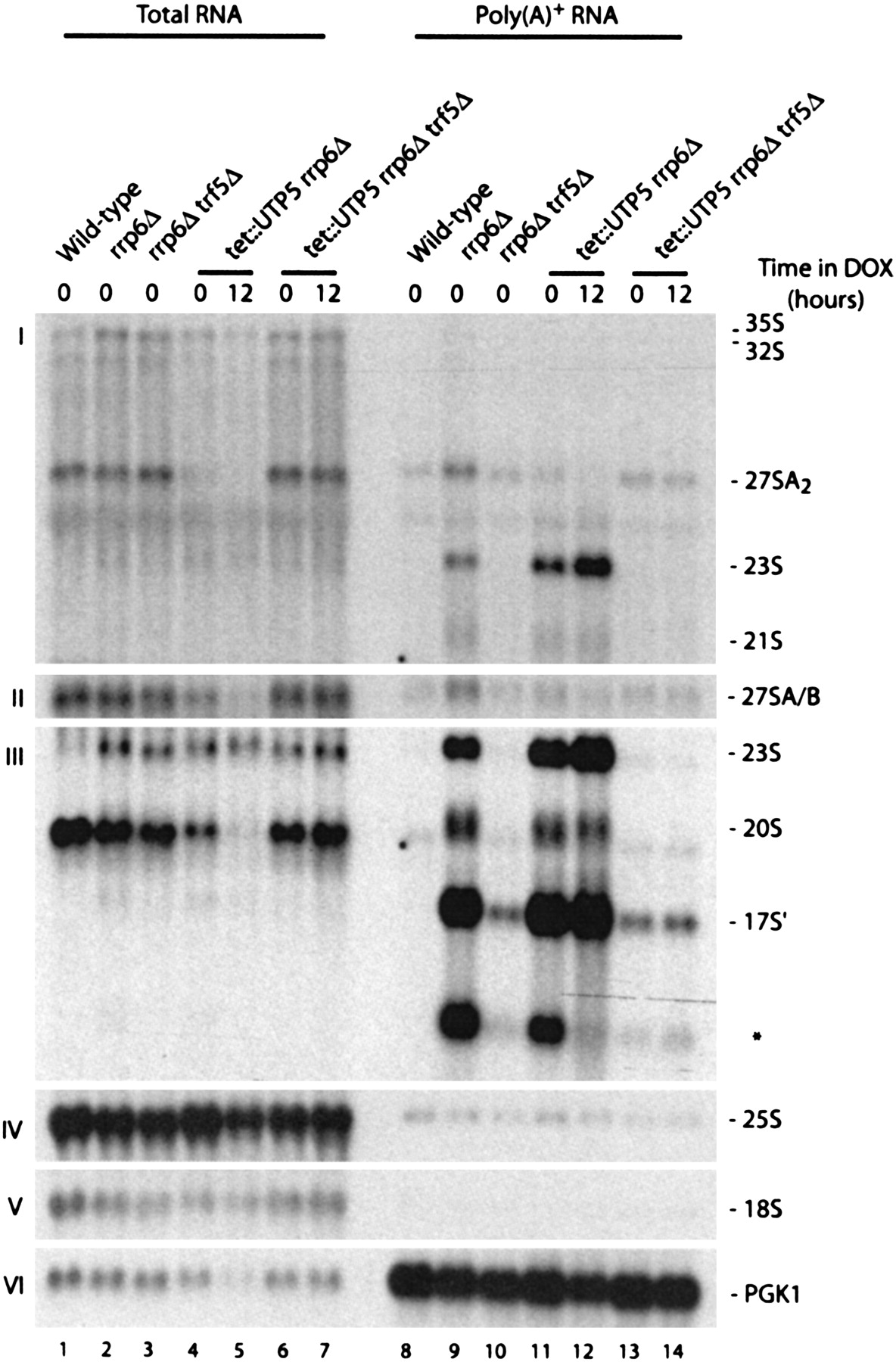
Pre-rRNAs accumulated in the absence of Utp5 are polyadenylated by Trf5. Total RNA was extracted from yeast strains grown to mid-log phase in complete medium and subjected to poly(A)+ affinity purification on oligo-dT coated beads. An otherwise isogenic wild-type strain, strains deleted for the Exosome cofactor Rrp6, or for Rrp6 and the TRAMP component Trf5, either in the presence (0 h time points) or in the absence of Utp5 (12 h depletion time points). Total RNA and purified poly(A)+ were loaded on a 1.2% agarose/formaldehyde gel in a 1:50 ratio. Northern blot hybridization with probes to pre-rRNA, mature rRNA, or the loading control PGK1, a highly expressed messenger RNA, the level of which is largely unaffected by Exosome mutations. Panel I was hybridized with oligo c; panel II with LD906; panel III with b; panel IV with f; panel V with a and panel VI with LD1142 (PGK1). A significant amount of the aberrant 17S′ RNA that extends from within the 5′ end of the 18S rRNA to A3 (Supplemental Fig. S1; Houseley and Tollervey 2006) remained polyadenylated in the absence of Trf5. It is currently not understood why the RNA species marked with an asterisk, and representing an as yet uncharacterized pre-rRNA degradation product (Houseley and Tollervey 2006), was not coprecipitated upon Utp5 depletion.




