


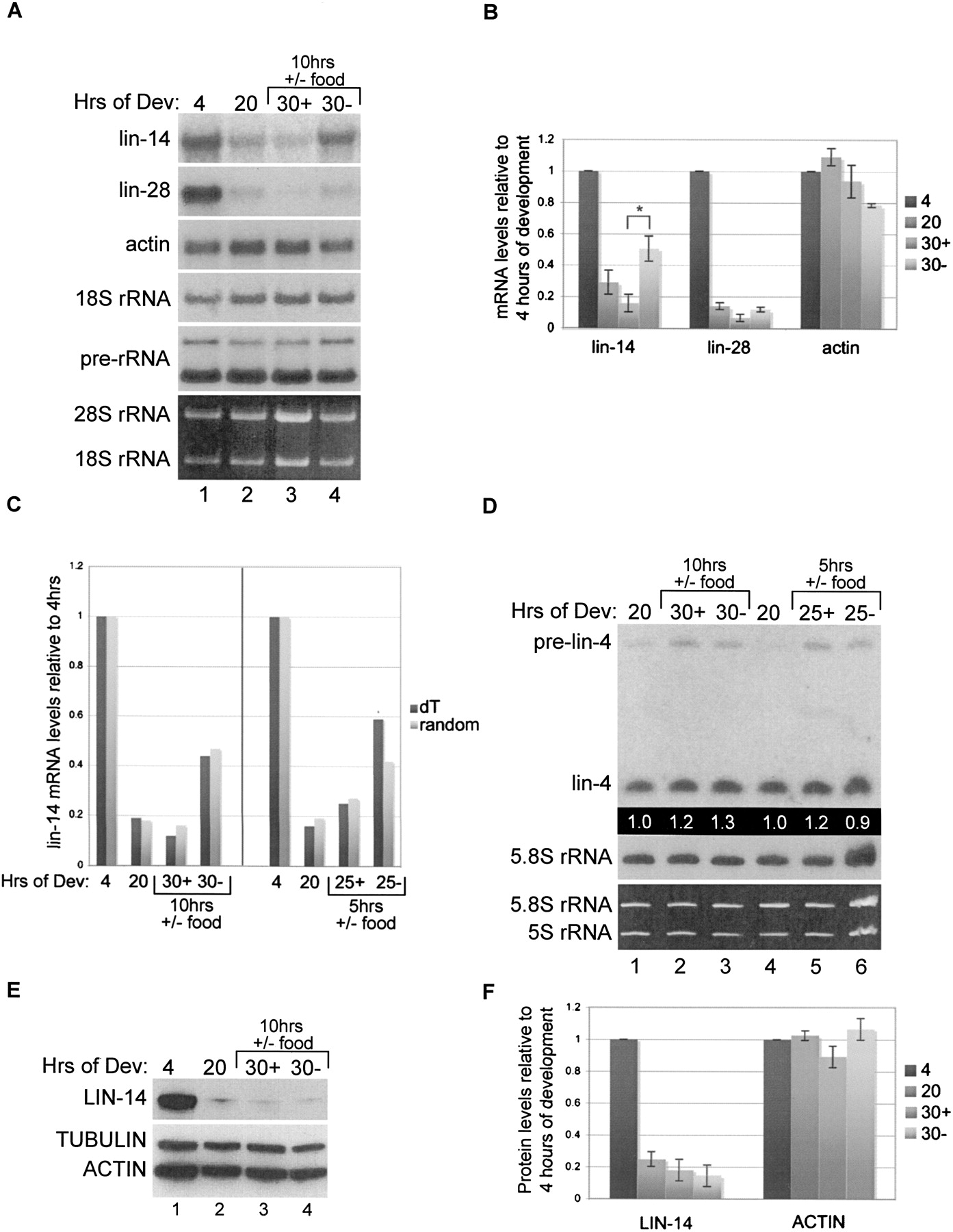
lin-14 mRNA but not protein is mis-regulated in worms removed from food. Wild-type worms were cultured on food and collected for RNA or protein at 4 and 20 h of development, and a portion of the 20-h population was replated with (+) or without (−) food for another 5 or 10 h and then collected at the 25-h or 30-h time points, respectively. (A) Total RNA was used for agarose Northern blot analyses to detect lin-14, lin-28, actin, 18S rRNA, and preribosomal RNAs. (B) The mRNA levels of lin-14, lin-28, and actin were normalized to 18S rRNA, and the levels relative to the 4-h time point were graphed. Quantification is the average from three independent experiments. Error bars represent SEM and *P < 0.05. (C) RNA samples from experiments with worms deprived of food for 10 h (left panel) or 5 h (right panel) were used for reverse transcription reactions using oligo dT (dark bars) or random (light bars) primers, and the resulting cDNA was used for quantitative PCR analyses. Samples were normalized to actin and lin-14 mRNA levels are graphed relative to the 4-h time point for each experiment. (D) The RNA used in C was subjected to PAGE Northern blot experiments to detect lin-4 miRNA and control 5.8S rRNA levels. Mature lin-4 miRNA levels were normalized to 5.8S rRNA, and levels relative to the 20-h time point for each experiment are indicated. (E) The same worm populations analyzed in C for the 10-h food deprivation experiment were also used to isolate protein and perform Western blotting to detect LIN-14, ACTIN, and control TUBULIN protein levels. (F) The protein levels of LIN-14 and ACTIN were normalized to TUBULIN, and the levels relative to the 4-h time point were graphed. Quantification is the average from three independent experiments. Error bars represent SEM.




