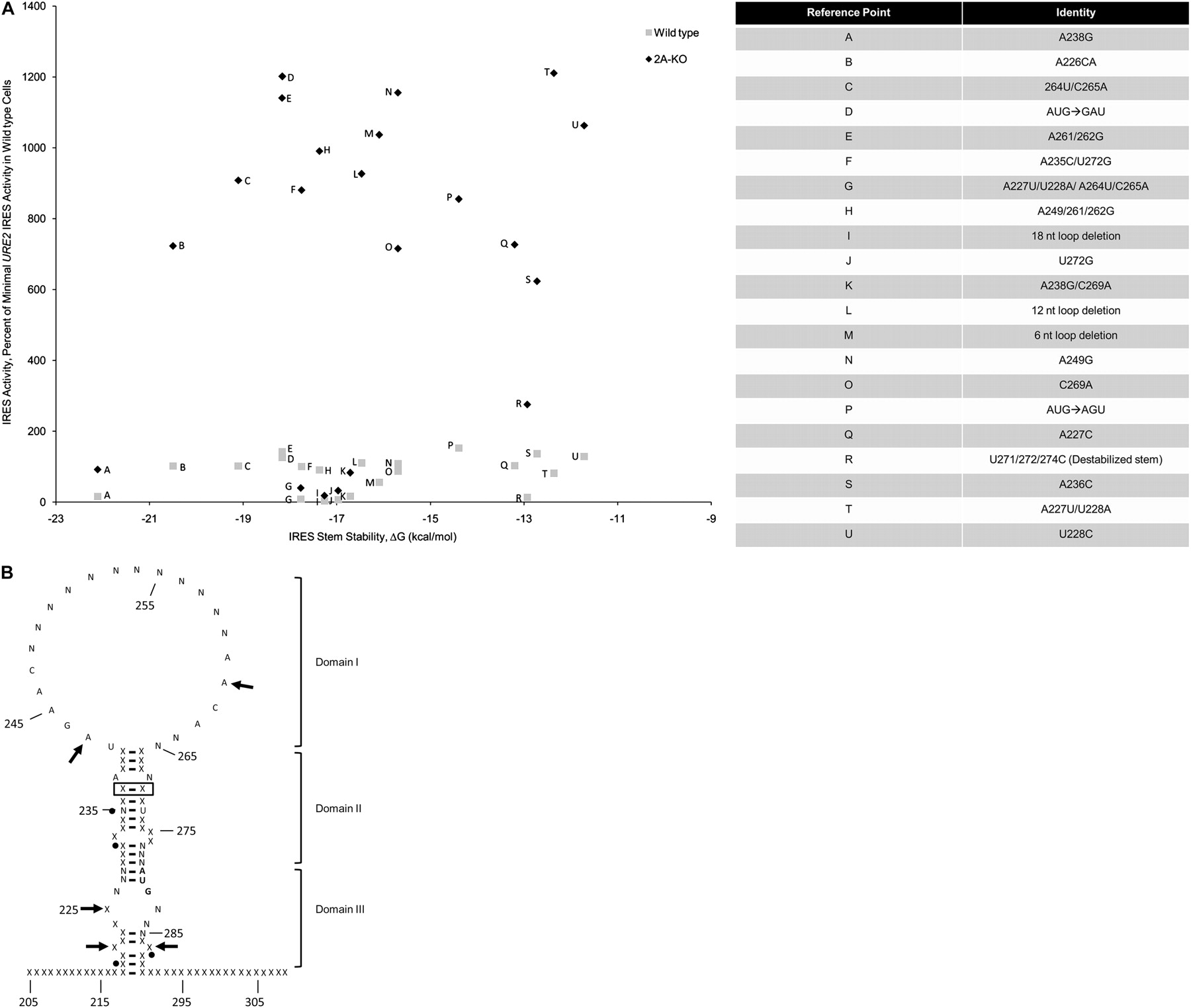
Overall stability of the URE2 minimal IRES stem is not critical for efficient internal initiation. (A) The activity of each mutant used previously (Reineke et al. 2008) and in this study was plotted against the predicted stability of the mutant URE2 minimal IRES element (left panel). Activity is represented as a percent of the wild-type minimal URE2 IRES element in wild-type cells (0.20671 Miller Units). Activity of each mutant is indicated by the same letter in both wild-type (gray boxes) and ΔeIF2A (2A-KO; black diamonds) yeast cells (right panel). (B) Nucleotides shown to be important for optimal IRES-mediated translation in functional assays are plotted on the structure of the minimal URE2 IRES element, which was determined previously. Nucleotides, not critical for efficient cap-independent initiation, are depicted with “N,” while those that are important are depicted with the single letter nucleotide code. Nucleotides lacking data indicating a functional role in internal initiation are denoted with “X.” Black dots highlight nucleotides participating in base-pair interactions that are partially covariable, and the black box highlights the single base pair that is covariable in phylogenetic comparisons. Block arrows denote single stranded nucleotides that vary without perturbing secondary structure as predicted by mFold.