


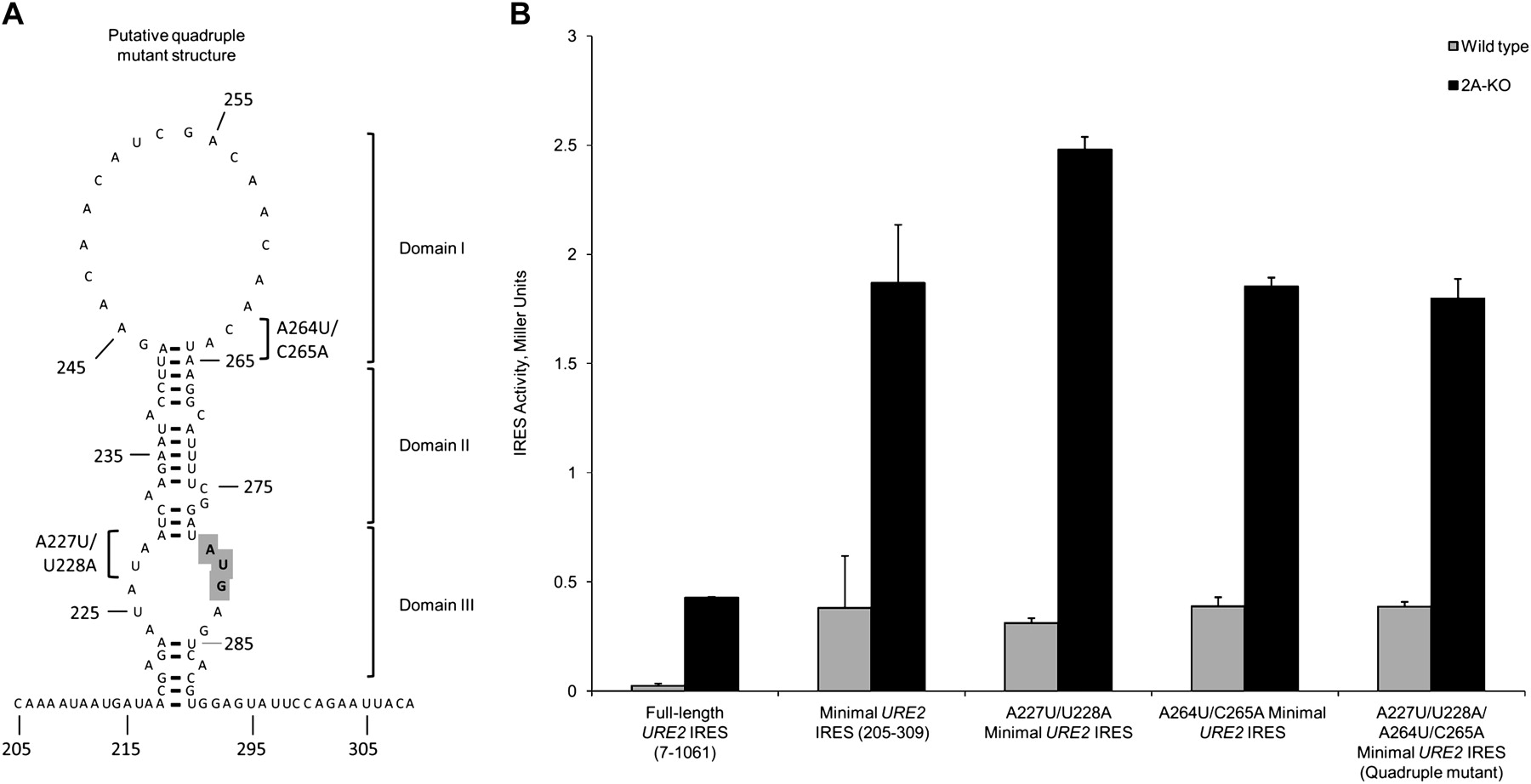
Alterations in both the size of the domain 2 stem and base pairs with the internal AUG codon do not affect levels of cap-independent initiation. (A) The putative structure of the minimal URE2 IRES element resulting from the quadruple mutant consisting of the addition of two base pairs in domain 1 (A264U and C265A) and removal of two base pairs in domain 3 (A227U and U228A) is shown. This structure was predicted using the Mfold structure prediction software (Mathews et al. 1999; Zuker 2003), and supported by biochemical data indicating the formation of the stem–loop structure for the wild-type minimal URE2 IRES element (Reineke et al. 2008). The mutations in domains 1 and 3 are indicated with brackets. Double mutants (A264U/C265A and A227U/U228A) are expected to result in alterations of only the domains in which the mutations are made (domains 1 and 3, respectively). (B) Activity of the double (A264U/C265A and A227U/U228A) and quadruple mutants (A264U/C265A/A227U/U228A) in the minimal URE2 IRES element were tested using the p281-4 reporter plasmid (Altmann et al. 1993) in both wild-type (gray bars) and ΔeIF2A (2A-KO; black bars) yeast cells, and are represented as in Figure 2.




