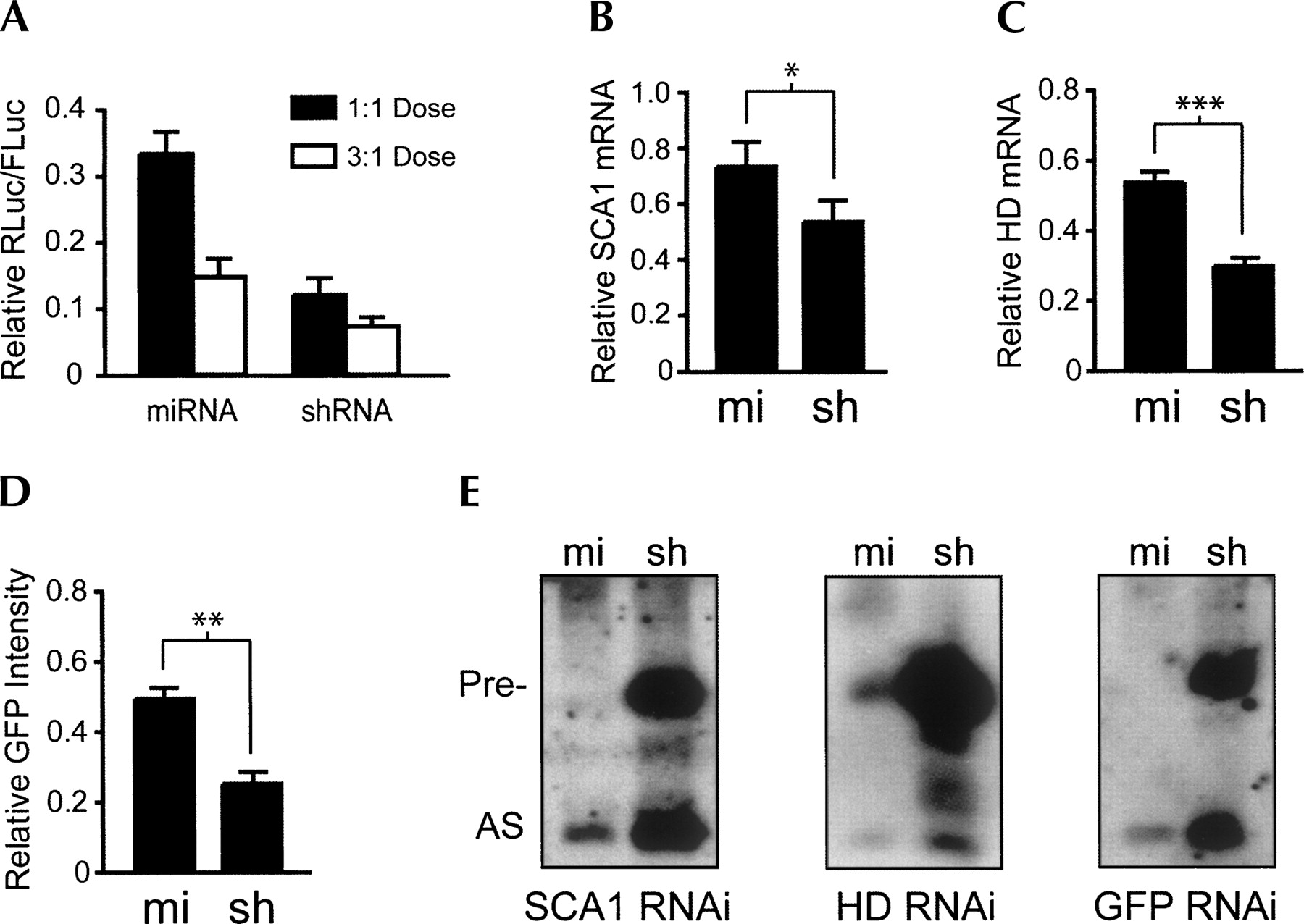
shRNAs are more potent than artificial miRNAs in vitro. (A) RNAi and RNAi luciferase reporter plasmids were cotransfected into HEK293 cells to assess gene silencing. Dual Glo Luciferase assays were performed at 24 h and results, shown as mean±SEM relative to mock-treated controls, were compiled from several experiments (4 GFP, 4 SCA1, and 2 HD; each n = 3). Dose is indicated as RNAi:target. P < 0.001 and P < 0.05 for 1:1 and 3:1 doses, respectively. (B,C) Plasmids expressing RNAi targeting SCA1 or HD were transfected into HEK293 cells, and Q-PCR analysis was performed at 48 h to measure reduction of endogenous transcripts. SCA1 and HD mRNA levels were normalized to GAPDH mRNA or 18S rRNA and are shown as mean±SEM (n ≥ 3, * = P < 0.05, *** = P < 0.001) relative to mock-treated controls. (D) GFP RNAi and eGFP expression plasmids were cotransfected into HEK293 cells, and fluorescence levels were evaluated 48 h later. Results are shown as mean±SEM (n = 4, ** = P < 0.01) relative to SCA1 RNAi-treated controls. (E) shRNA and artificial miRNA expression plasmids were transfected into HEK293 cells, and small transcript Northern blot was performed at 48 h to assess RNAi expression and processing. (Pre-) precursor; (AS) antisense RNA. Results show that shRNAs yield more than fourfold mature antisense RNA, relative to artificial miRNAs, independent of RNAi target sequence. These results were consistent among triplicate blots for each RNAi vector pair.