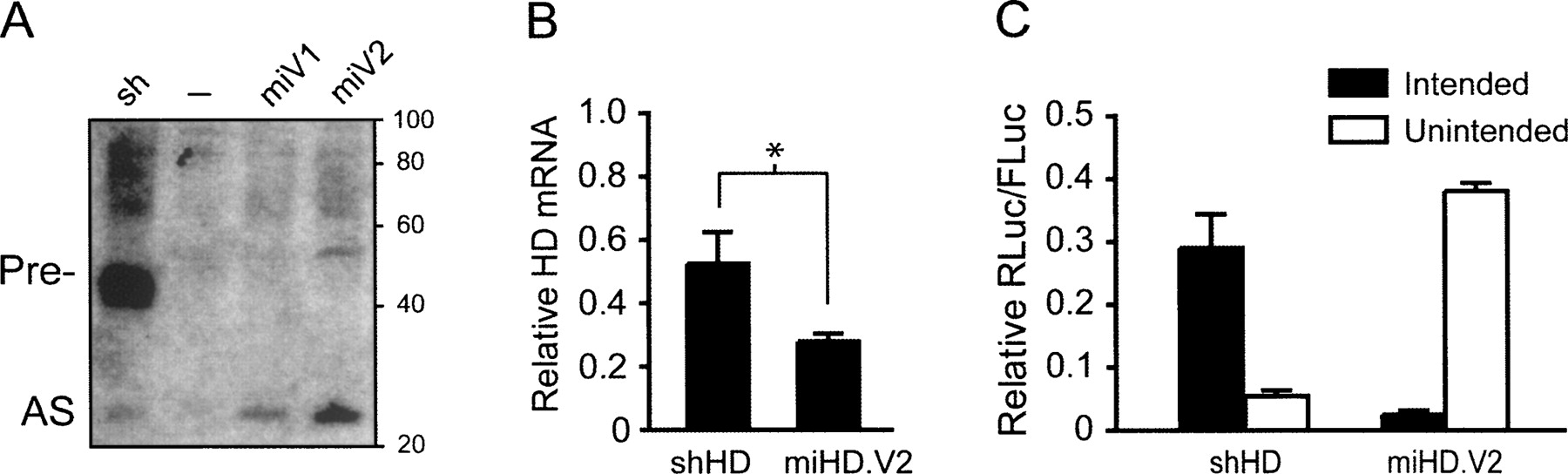
Disparate strand biasing confounds shRNA and artificial miRNA comparisons. (A) Small transcript Northern blot performed at 48 h post-transfection of HD2.1 RNAi expression plasmids in HEK293 cells shows improved yield of processed antisense RNA (AS) from CMV-driven artificial miRNA variants 1 and 2 (miV1, miV2) relative to the U6-driven first-generation shHD2.1 and a mock-treated sample (–). Pre- designates the precursor stem–loop. (B) Q-PCR analysis for endogenous HD mRNA levels performed 48 h after transfection of HD2.1 RNAi expression plasmids into HEK293 cells. Results were normalized to GAPDH mRNA levels and are shown as mean±SEM relative to mock-treated samples (n =3, * = P < 0.05). (C) Strand biasing of U6-driven HD2.1 RNAi vectors. Strand biasing was assessed by measuring luciferase activity from reporters containing either sense (intended; binds RNAi antisense) or antisense (unintended; binds RNAi sense) target sequences in the 3′ UTR (Fig. 1C). RNAi reporter and RNAi expression plasmids were cotransfected into HEK293 cells, and Dual-Glo Luciferase assays were performed at 24 h. Results are shown as mean±SEM (n = 4) relative to mock-treated controls and demonstrate that shHD2.1 preferentially loads the unintended siRNA strand while miHD2.1 more often loads the intended strand.