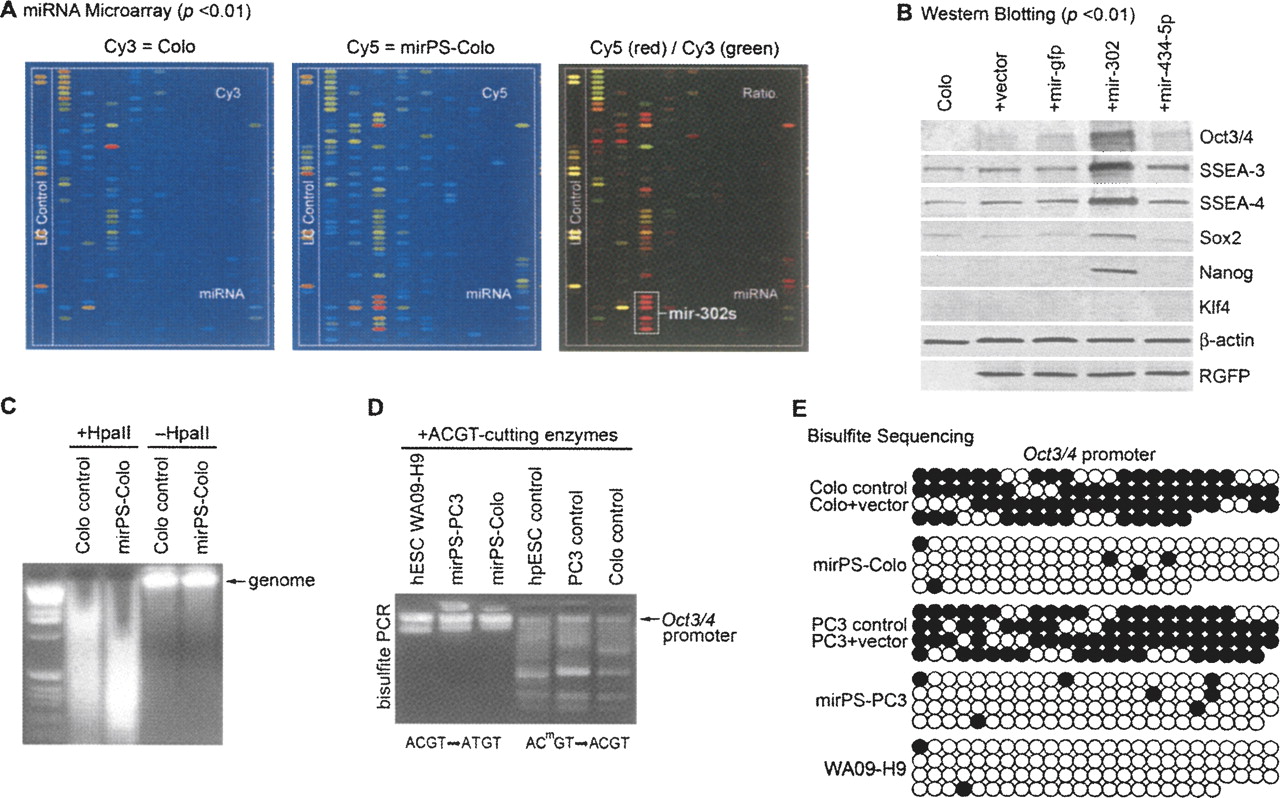
Correlation among mir-302 transfection, ES marker expression, and genomic DNA demethylation in mirPS cells. (A) Microarray analyses of miRNA expression, revealing that all mir-302 familial members (mir-302s) were highly expressed in the mirPS-Colo rather than original Colo cells (n = 3 , P < 0.01). (B) Western blot analyses, showing that mirPS cells expressed high levels of human ES cell markers, including Oct3/4, SSEA-3, SSEA-4, Sox2, and Nanog, but not oncogenic Klf4 (n = 4, P <0.01). (C) HpaII cleavage showing the loss of global CpG methylation at a genome-wide scale in mirPS cells. (D) Bisulfite modification of unmethylated ACGT into AUGT sites in the 9400-bp regulatory region of the Oct3/4 promoter, showing an increase of unmethylated ACTG (AUCT) sites in mirPS cells. (E) Bisulfite DNA sequencing, showing the detailed methylation maps flanking the transcription initiation site of the Oct3/4 promoter. Black and white circles indicate the methylated and unmethylated cytosine sites, respectively.