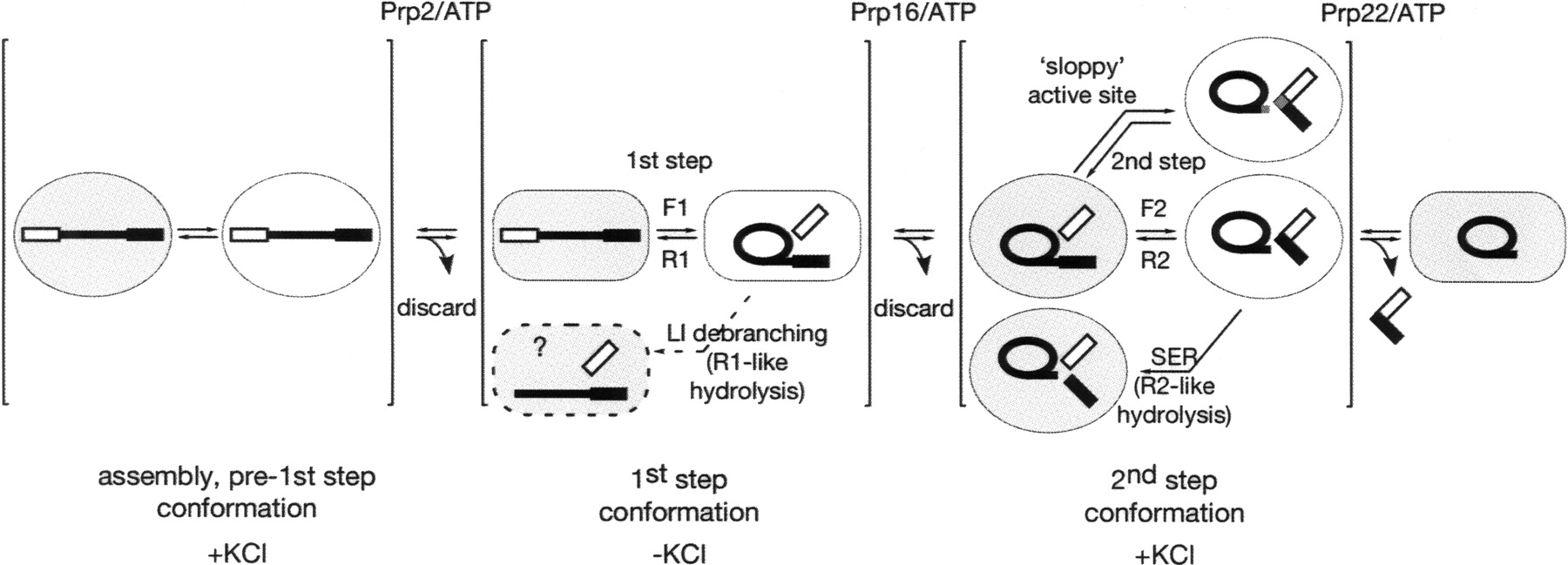
Schematic depiction of the observed and potential reactions occurring during reversible splicing catalysis by compositionally homogeneous spliceosomes, as described by Tseng and Chen (2008). Given the need for catalytic center opening and substrate repositioning between the two catalytic steps (Liu et al. 2007), a complex containing lariat intermediate and free 5′ exon could plausibly be in one of at least four conformations that remain conformationally undefined: post-first step but preopening, open but unrepositioned, open and repositioned, or closed pre-second step. Similarly complex transitions may also be required at other steps shown here as a single transition. KCl stimulates the forward second step and reverse first step: It is unclear, however, precisely which states along the splicing pathway are relatively stabilized or destabilized by KCl.