


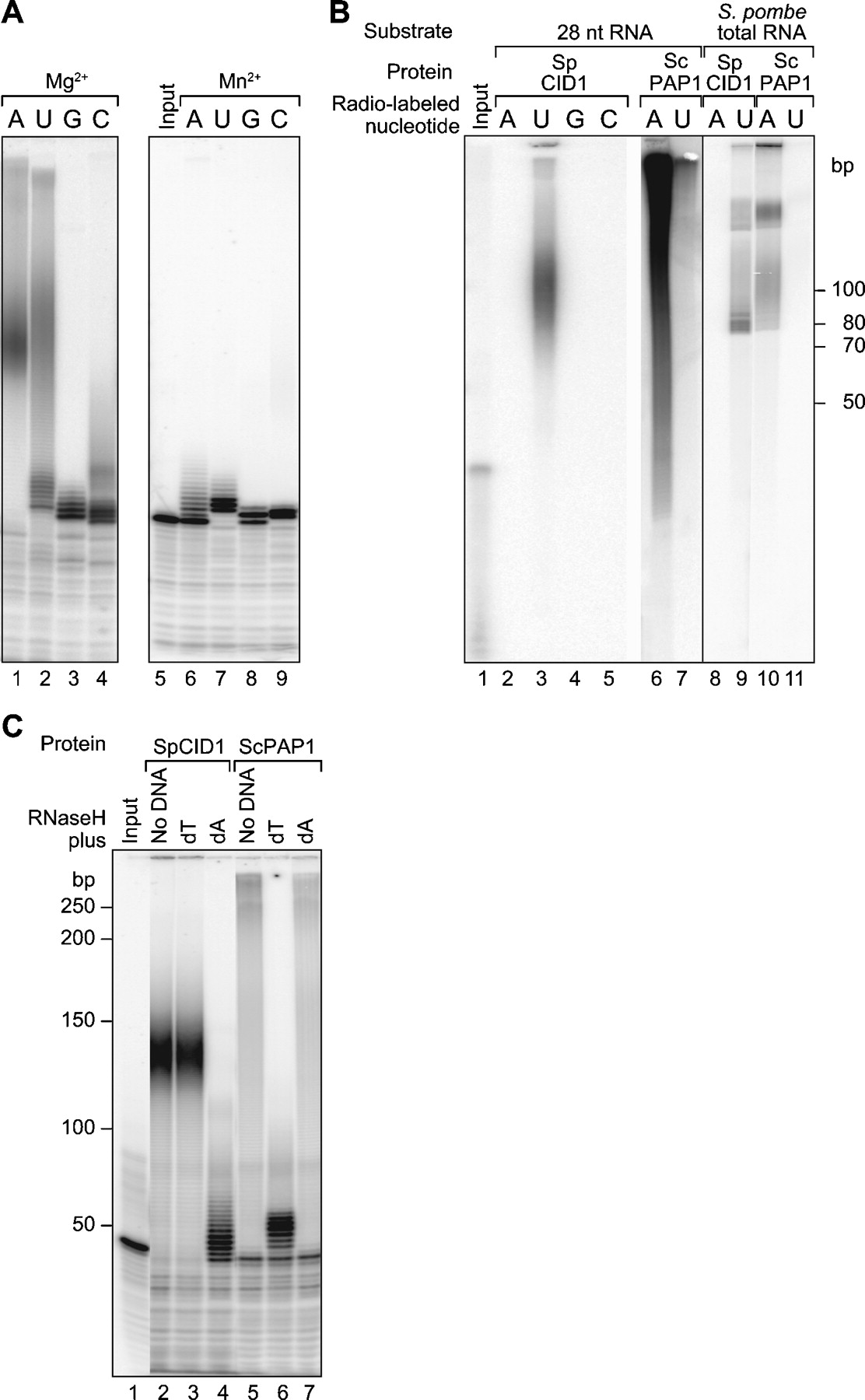
SpCID1 activity in vitro. (A) Divalent metals. Purified recombinant SpCID1 was incubated with a 32P-labeled RNA substrate and one of four nucleoside triphosphates. Reactions contain either MgCl2 or MnCl2, as indicated above the lanes. (B) Preference for UTP and poly(U) synthesis in vitro. (Lane 1) End-labeled RNA corresponding to the substrate of the reactions in lanes 2–7. (Lanes 2–5) SpCID1 was incubated with an unlabeled RNA substrate and all four nucleoside triphosphates. Reactions contained either 32P-labeled ATP, UTP, GTP, or CTP, as indicated above each lane. Only UTP was significantly incorporated. (Lanes 6,7) Recombinant ScPAP1 was incubated with an unlabeled RNA substrate and the four nucleoside triphosphates plus either 32P-labeled ATP or UTP, as indicated. (Lanes 8–11) Similar reactions using total RNA from S. pombe as a substrate. (C) Oligo(dA)/RNaseH treatment confirms that the products of SpCID1 are poly(U). In vitro reactions were performed using radiolabeled RNA substrates and four NTPs. The products were treated with RNase H and either oligo(dA) or oligo(dT), as indicated. (Lane 1) substrate RNA (no A or U added); (lanes 2,5) no oligonucleotides added; (lanes 3,6) oligo(dT) added; (lanes 4,7) oligo (dA) added.




