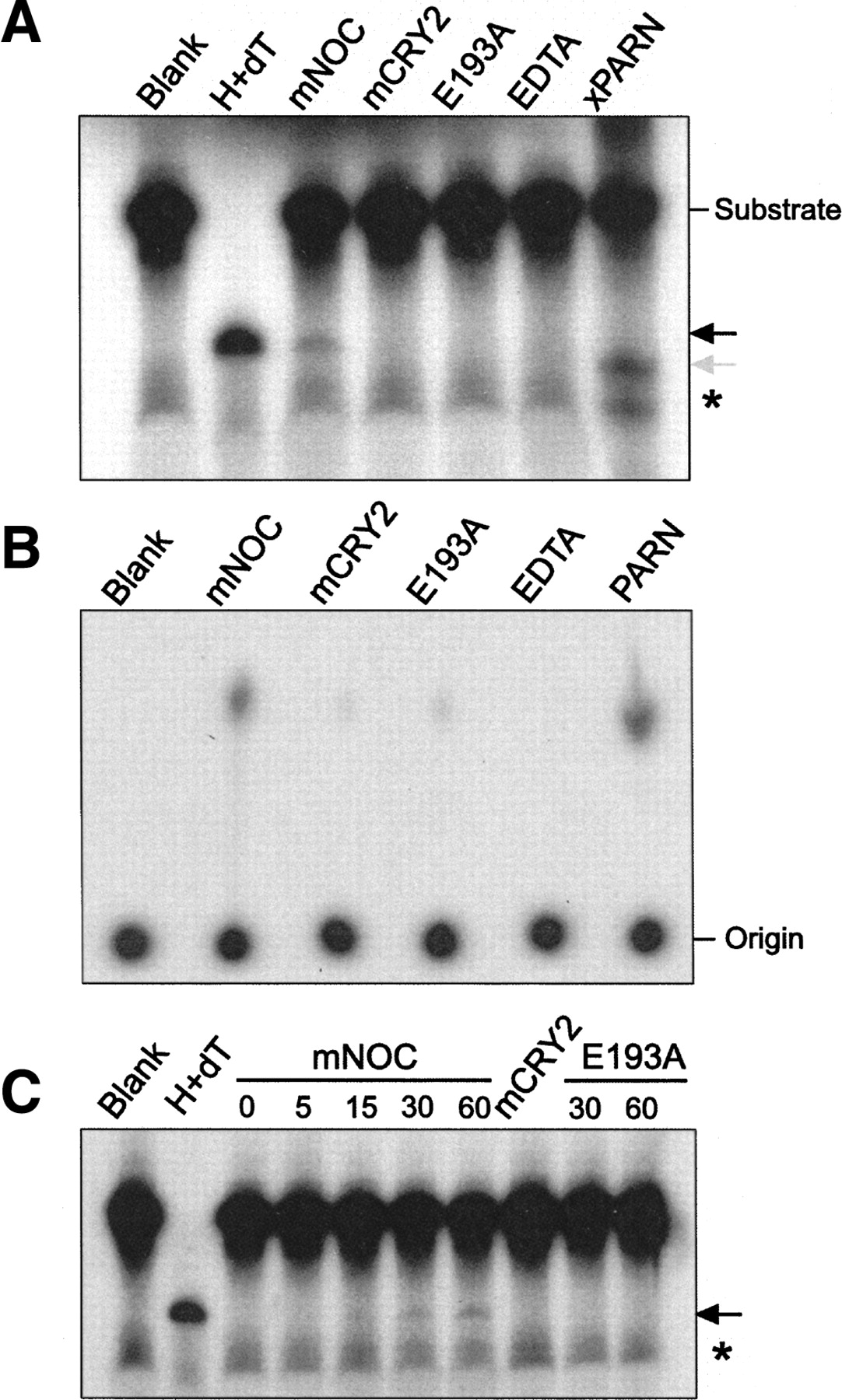
mNOC is a processive deadenylase. (A) Autoradiography showing the products of an in vitro deadenylase assay separated by electrophoresis in a polyacrylamide/urea gel. The synthetic RNA substrate (body, 86 nt; polyA tail, 100 nt; 1 × 10⁵ dpm, ∼1.5 ng) was labeled with (α-32P)-UTP and incubated for 30 min with different proteins (500 ng) in the presence of buffer and Mg2+. (B) Autoradiography showing the products of a deadenylase assay where the substrate was transcribed in the presence of (α-32P)-ATP (both tail and body were radiolabeled) and resolved by TLC. (C) Deadenylation assay (as in A) showing the product accumulation over time (minutes indicated on the top). The experiments shown are representative of n = 4 in A, n = 1 in B, and n = 2 in C. (Blank) No protein control, (H+dT) the substrate was incubated with RNase H in the presence of oligo(dT) to generate a deadenylated marker, (mNOC) GST-mNOC, (mCRY2) GST-mCRY2, (E193A) predicted GST-mNOC Mg2+-binding mutant, (EDTA) 25 mM EDTA, and GST-mNOC were added at the beginning of the reaction, (xPARN) xPARN-His. Note that while the GST-tagged proteins were incubated linked to sepharose beads, PARN-His was added in solution. (Black arrow) Mobility of the deadenylated product, (gray arrow) a PARN activity product (this enzyme, in addition to the polyA tail, trims a few nucleotides into the body), and (asterisk) nonspecific band present in all lanes.