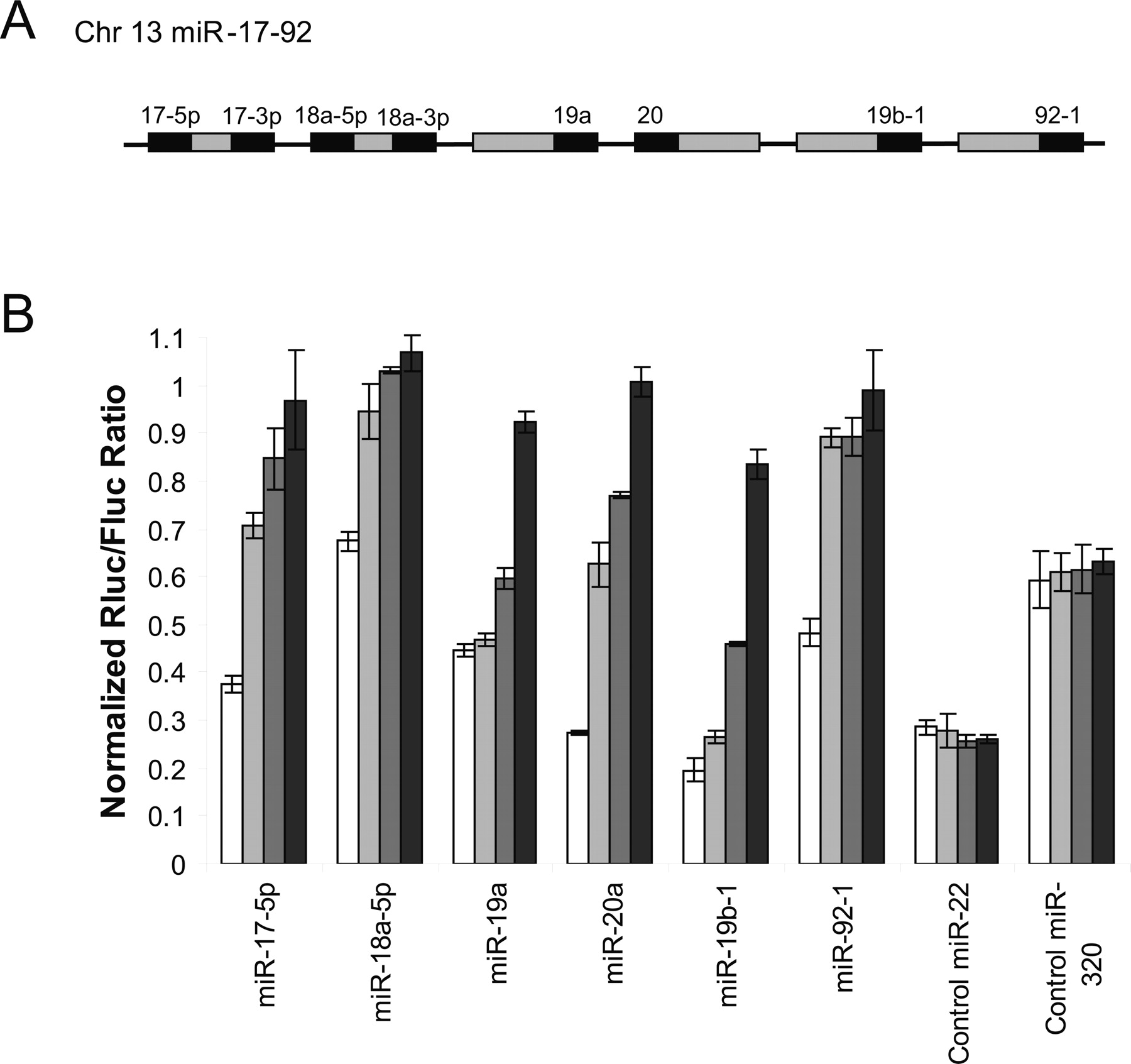
Combinatorial inhibition of microRNA function. (A) Diagram showing genomic organization of the mir-17–92 cluster on chromosome 13 (He et al. 2005). (B) Six miRNAs (mir-17–5p, mir-18a-5p, mir-19a, mir-20, mir-19b-1, and mir-92–1) from the cluster were inhibited by pools of three different inhibitor designs (the reverse complement of the mature miRNA only [RC]; light gray bars), the reverse complement of the mature miRNA plus 16-nt flanking each side (16 + RC + 16, dark gray bars), and the reverse complement of the mature miRNA flanked on both sides by hairpin sequences (hp + RC + hp, black bars). Values with no inhibitor are shown by white bars. All six inhibitors of each design were pooled for a 0.8 nM total inhibitor concentration. These pools were cotransfected into HeLa cells with one of six reporter plasmids for each of the miRNAs or one of two control reporter plasmids for unrelated miRNAs (miR-22, miR-320) not included in the cluster.