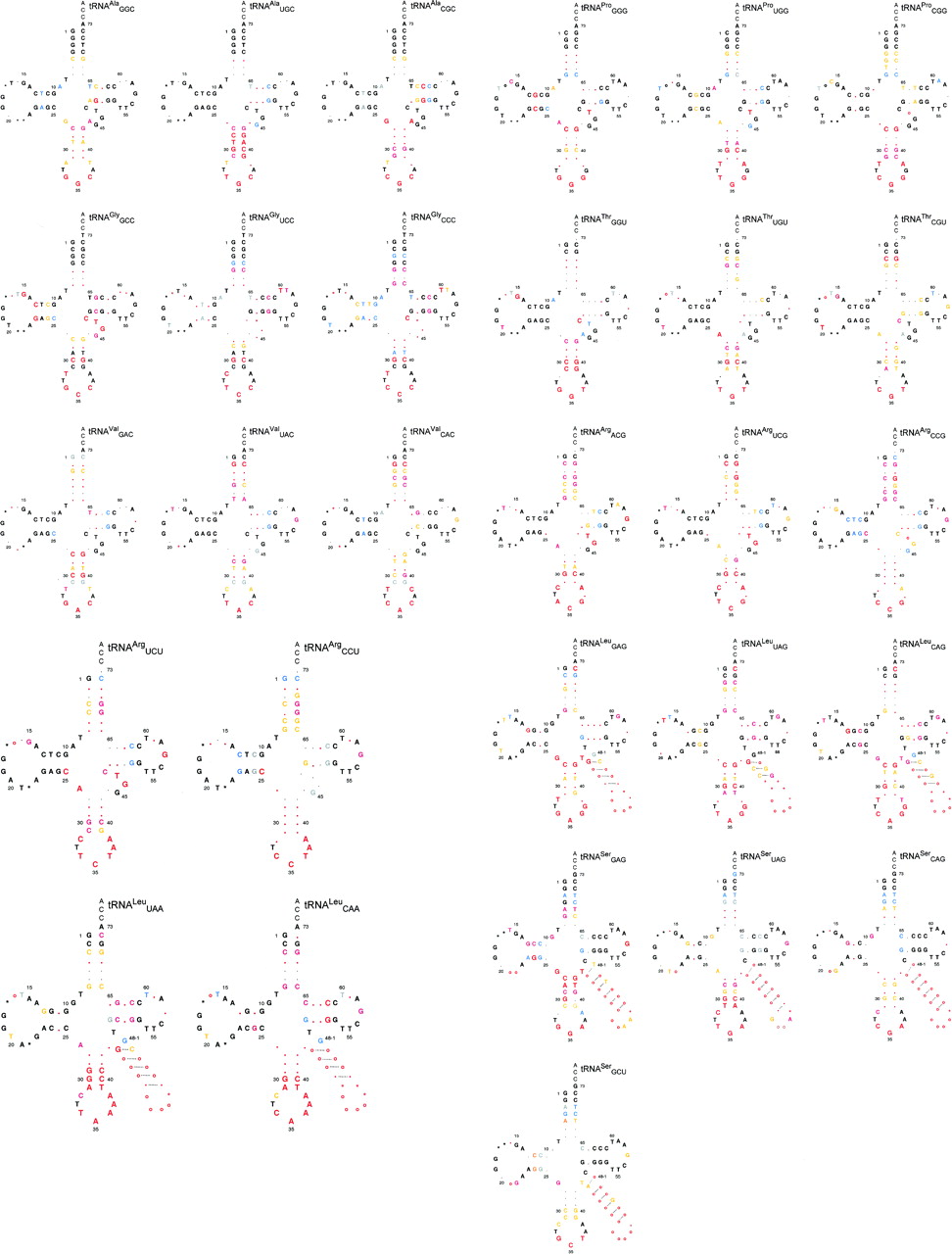
Sequence conservation among tRNA genes from 145 species, which represent the major lineages of the bacteria. The conserved residues are displayed on cloverleaf diagrams of alanine, arginine, glycine, leucine, proline, serine, threonine, and valine tRNA gene sequences that have been grouped according to the encoded anticodon triplet. The standard single-letter abbreviations are used to indicate the residues that are conserved at each position: (G) guanine, (A) adenine, (C) cytosine, (T) thymine; periods indicate that no residue is conserved. Nucleotide frequencies at positions that are conserved on the basis of amino acid family are indicated as: (black) 90%–100%; (blue) 80%–89%; and (gray) 70%–79%. Nucleotide frequencies at positions that are detected as conserved once the tRNAs for each amino acid family are separated according to the anticodon triplet are indicated as (red, large font) 90%–100%; (dark pink) 80%–89%; and (orange) 70%–89%. Symbols at the variable positions (17, 17a, 20a, 20b, and 47, the variable arm of leucine and serine tRNAs) indicate whether the position is conserved as (o) occupied; (*) unoccupied; or (period, .) neither. The 3′-terminal CCA was not included in the analyses.