


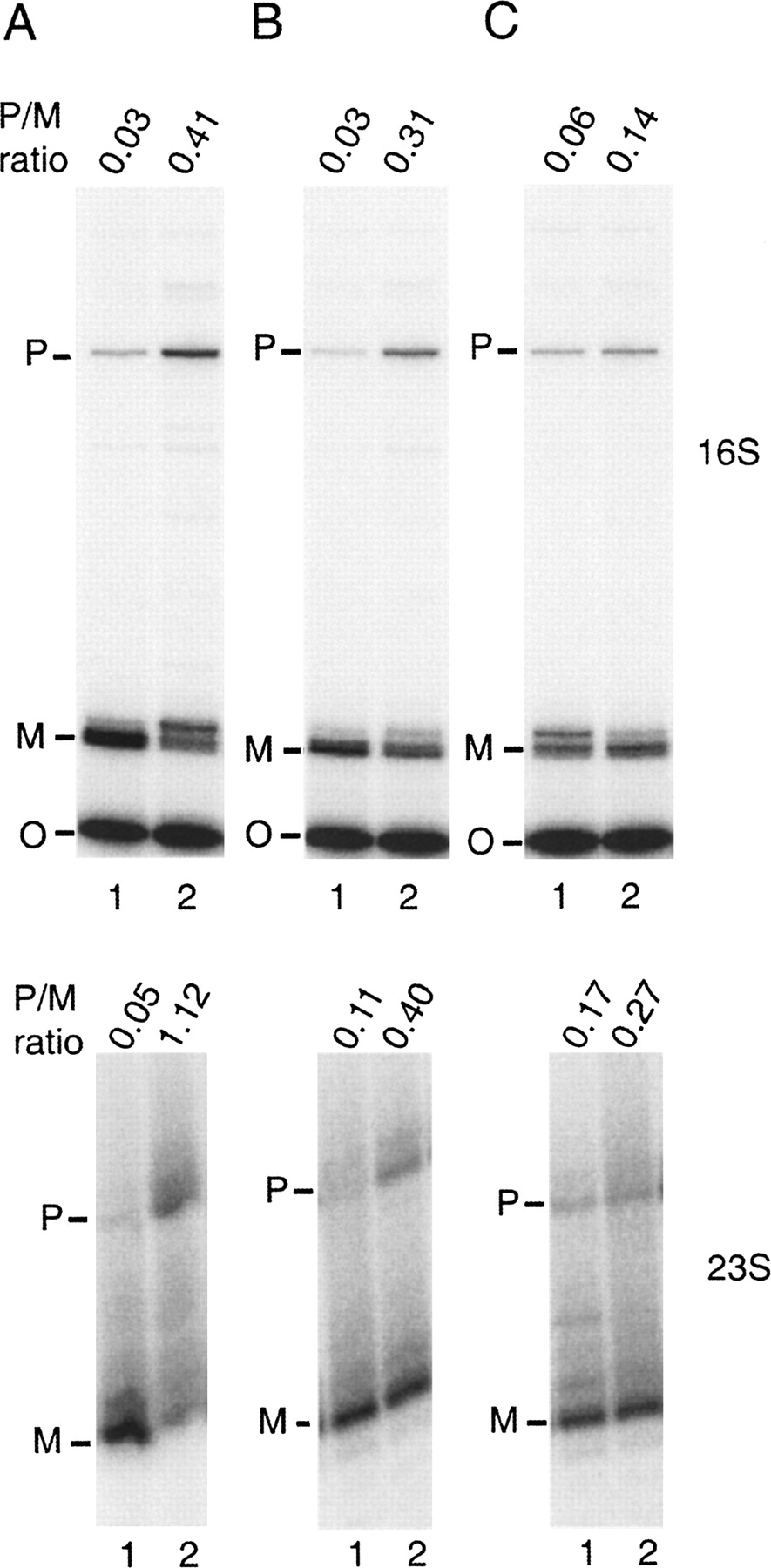
RNA analysis of strains containing additional tRNA defects. RNA was isolated from strains containing different tRNA defects and from isogenic wild-type strains, and rRNA processing was analyzed by primer extension with 16S and 23S rRNA-specific primers. Oligonucleotide primer (O), precursor (P), and mature (M) products are noted, as are the P/M ratios. (A) Isogenic strains NHY312 and NHY322 (rnpA49) were grown at 30°C to midlog phase, followed by transfer to 42°C for 30 min prior to harvesting. RNAs were analyzed by primer extension using 16S and 23S rRNA-specific primers. (Lanes 1) RNA derived from NHY312; (lane 2) RNA derived from NHY322. (B) Strains CA244 and CA244tRNATrp(ts) were grown at 30°C to midlog phase, followed by transfer to 42°C for 30 min prior to harvesting. RNA was isolated from these strains and analyzed by primer extension. (Lane 1) CA244; (lane 2) CA244tRNATrp(ts). (C) Strain CJ1825 was transformed with the control plasmid, pMPM-A4, or with pER133, a plasmid containing a short open reading frame that includes eight tandem AGA codons. The transformed strains were grown in LB+ampicillin at 37°C, followed by the addition of arabinose to 0.2% when the strains were at midlog phase, to induce transcription of pER133. Cultures were harvested after further growth for 15 min, followed by RNA isolation and analysis. (Lanes 1,2) RNA isolated from CJ1825/pMPM-A4 and CJ1825/pER133 cultures, respectively.




