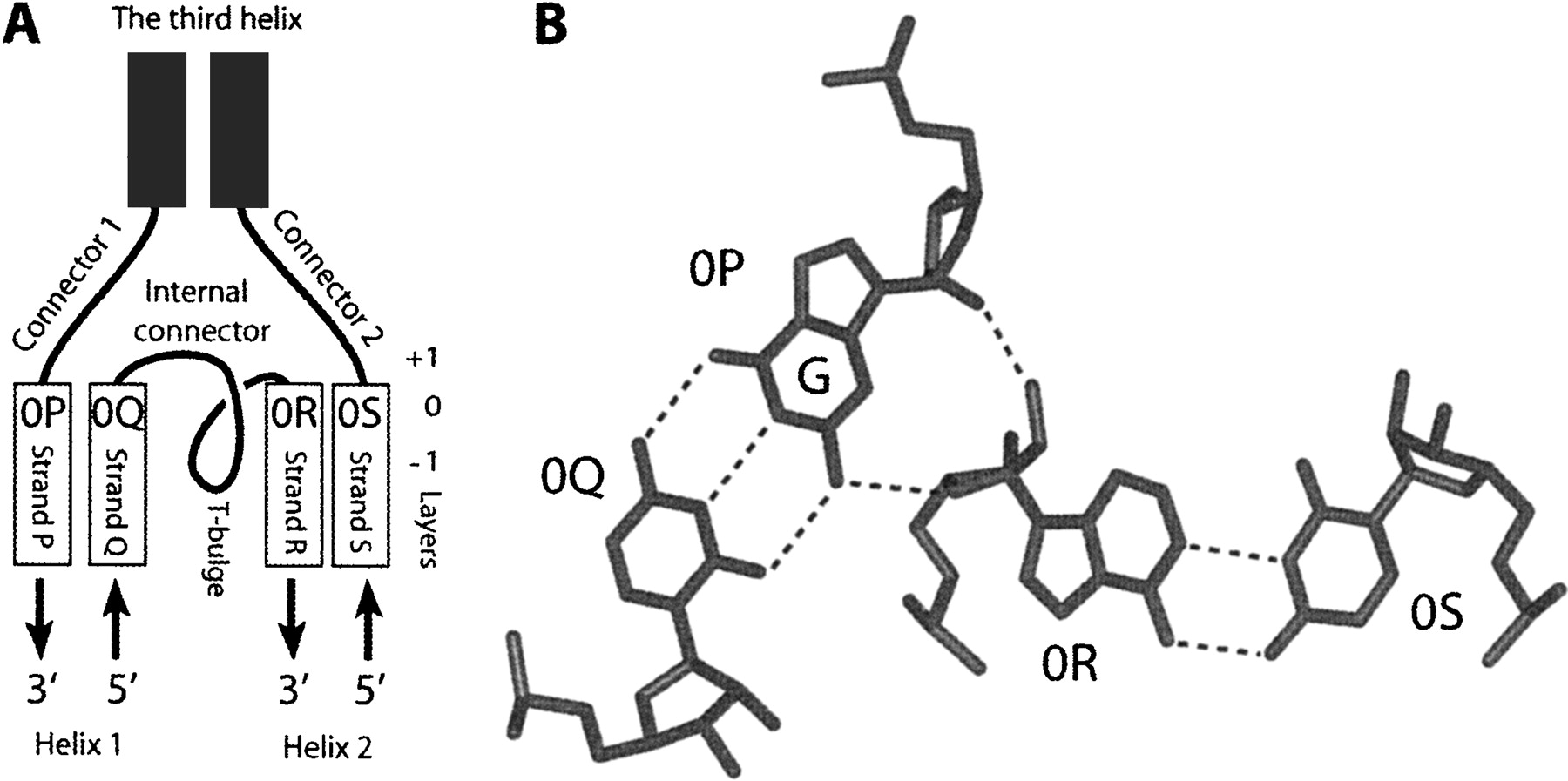
(A) The definition of different elements of the G-ribo motif. (Rectangles) Helical strands; (curves) unpaired regions. Helix 1 consists of strands P and Q, while Helix 2 consists of strands R and S. The third helix exists only, in some cases, of the G-ribo motif. In all cases of the motif, the 3′ part of the internal connector makes a loop that we call the T-bulge (see the text and Fig. 3). The top base-pairs [0P;0Q] and [0R;0S] of Helices 1 and 2, respectively, form the zero layer. The positions of layers −1, 0, and +1 are shown on the right. (B) The juxtaposition of the two zero base pairs, [0P;0Q] and [0R;0S]. (Dashed lines) Hydrogen bonds within and between the base pairs. In this juxtaposition, the ribose of 0R interacts with the ribose and the base of 0P. To make this interaction possible, 0P should be guanosine.