


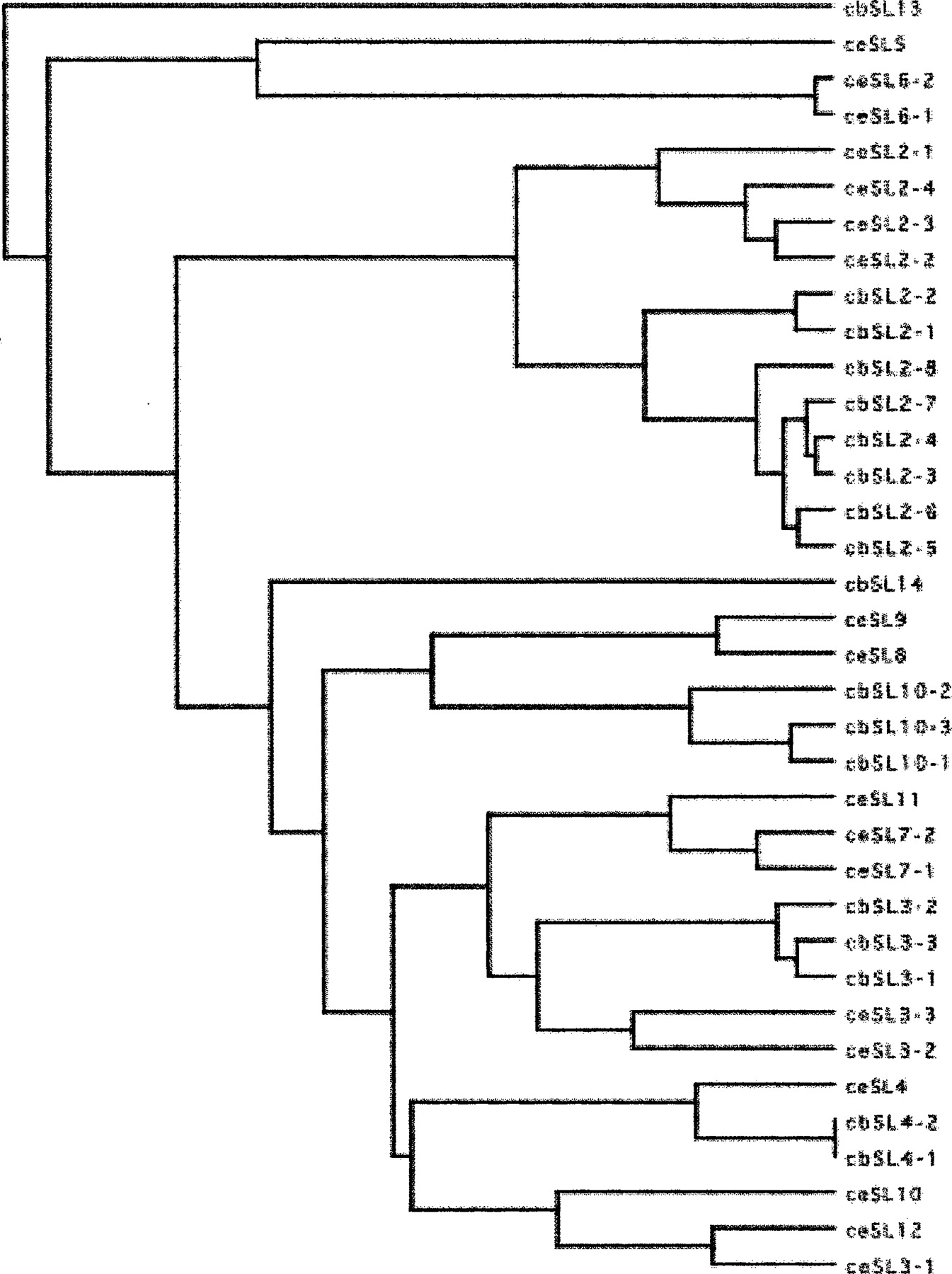
The Caenorhabditis SL2 RNA genes. The SL2 RNA genes from both Caenorhabdidtis species were identified by BLAST and the alignment and dendrogram produced as in Figure 2. C. elegans (ce); C. briggsae (cb). We have adopted the terminology of Thierry-Mieg (pers. comm.) in which the C. elegans genes are designated SL2–SL12 depending on their frequency in the C. elegans EST database, with SL2 being the most abundant and SL12 the least. Note that these names are dependent on the donated leader sequence, rather than the entire SL RNA sequence, so a single spliced leader is specified by several different genes. For example, SL2 is specified by four genes in C. elegans and eight genes in C. briggsae that contain sequence differences in the SL RNA, but no differences in the spliced leader. In the case of SL3 RNA, identical SLs are specified by distantly related genes (CeSL3-1 closely related to CeSL12; and CeSL3-2 and CeSL3-3 that tree together). The C. briggsae genes are named based on the sequences of their SL, but with two sequences not found in C. elegans called SL13 and SL14. Thus C. briggsae has the following spliced leaders: SL1, SL2, SL3, SL4, SL10, SL13, and SL14.




