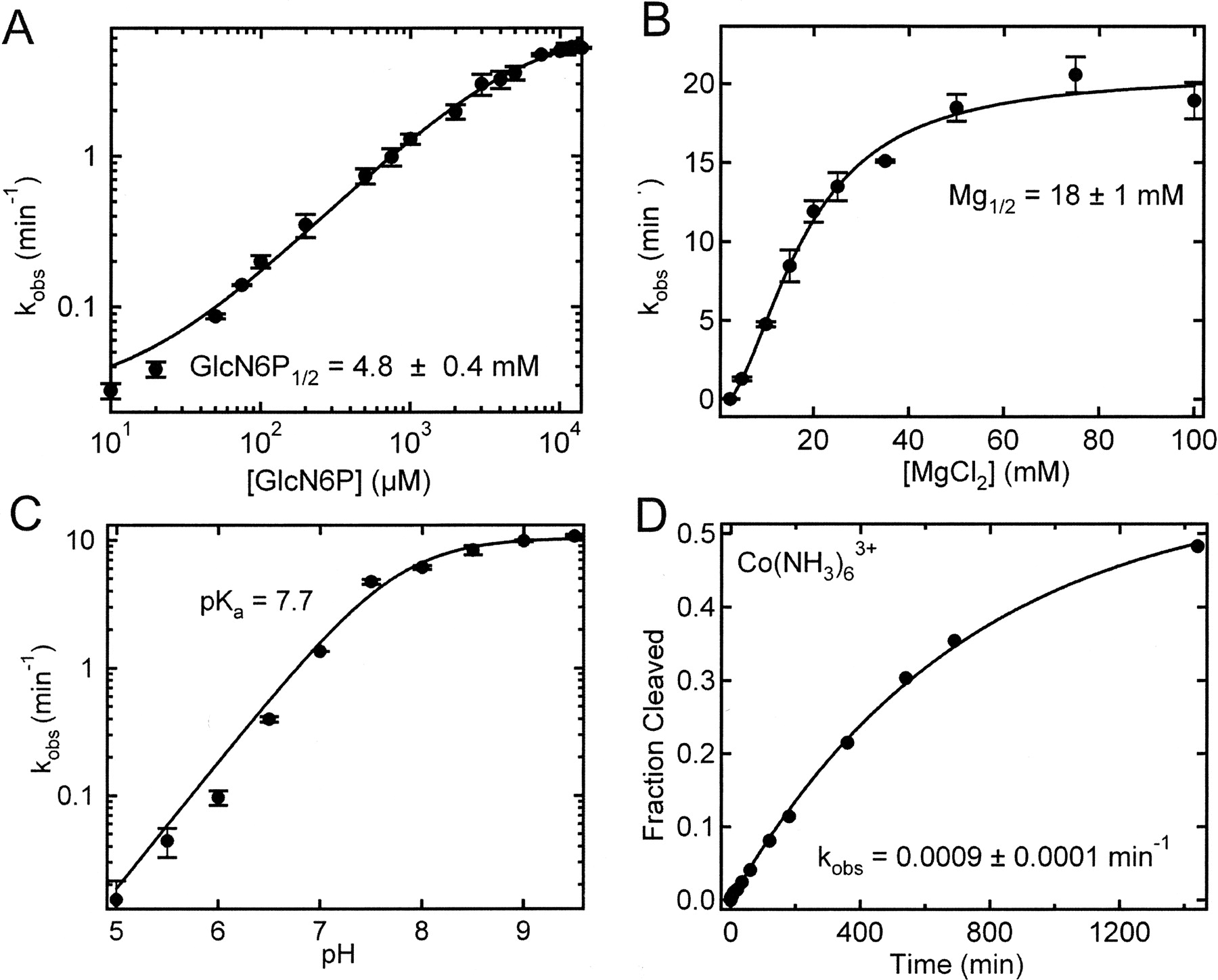
Characteristics of glmS catalytic riboswitch cleavage in trans. (A) Dependence of cleavage rate, k obs, on GlcN6P concentration under standard buffer conditions at 25°C and a ribozyme concentration of 100 nM. Data were fit with a cooperative binding equation (Materials and Methods) to yield the reported dissociation constant (cooperativity constant n = 1). (B) Observed cleavage rate constants, k obs, as a function of Mg2+ concentration in 50 mM HEPES-KOH (pH 7.5) and 200 mM KCl at 25°C in the presence of 10 mM GlcN6P and a ribozyme concentration of 100 nM. The experimental data were fit with a binding equation to yield the reported apparent Mg2+ dissociation constant Mg1/2 = 18 mM (cooperativity constant n = 2). (C) pH dependence of the observed cleavage rate constants, k obs, under standard buffer conditions in the presence of 10 mM GlcN6P and 100 nM ribozyme. The data were fit as described in Materials and Methods (solid line) to yield a pKa of 7.7. (D) Cleavage time course of the glmS ribozyme in the presence of 1 mM Co(NH3)6 3+ in 50 mM HEPES-KOH (pH 7.5), 200 mM KCl, at 25°C, and a ribozyme concentration of 100 nM in the presence of 10 mM GlcN6P. Data were fit with a single-exponential increase function to yield the reported rate constant k obs.