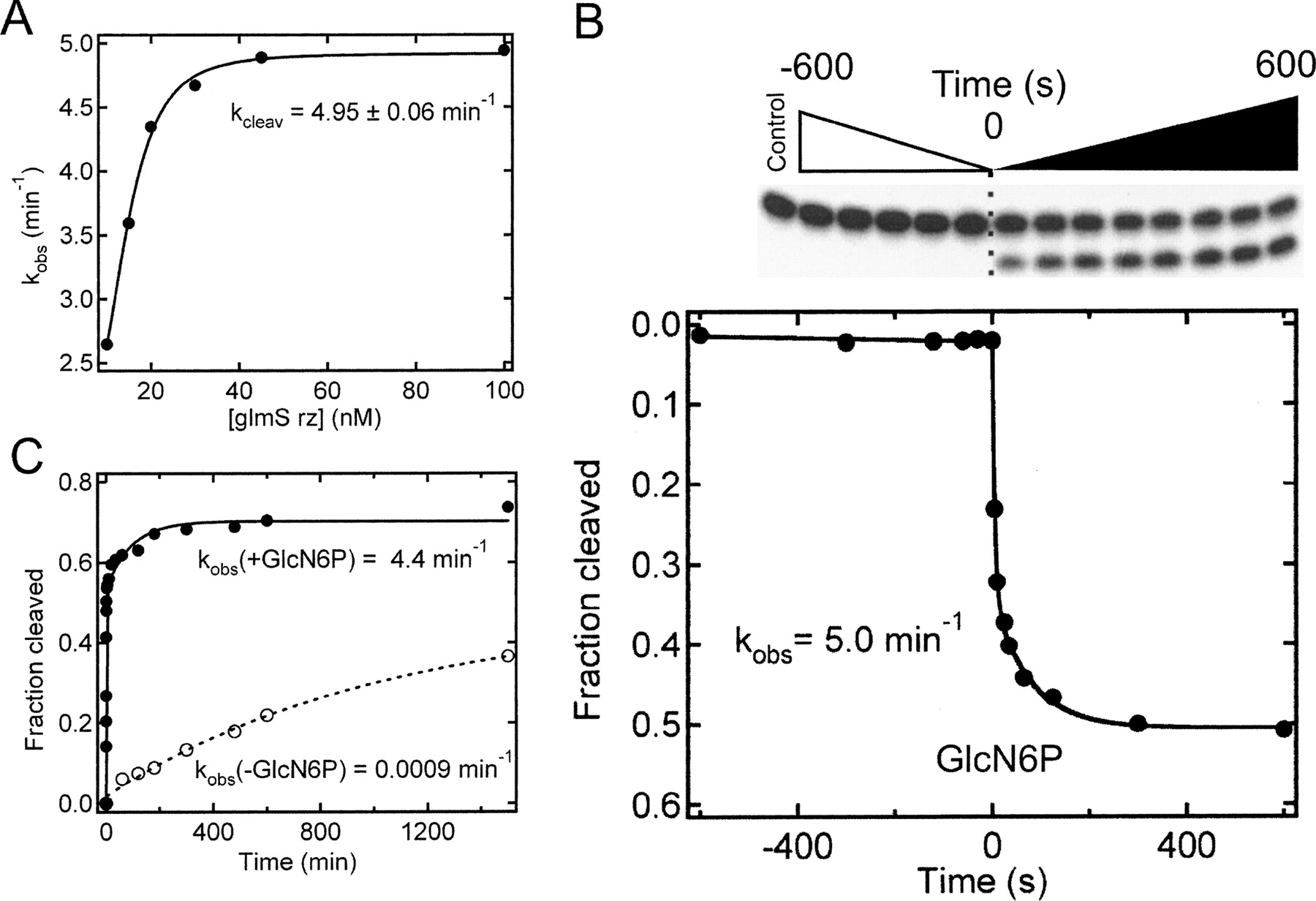
Cleavage activity of the trans-acting glmS catalytic riboswitch. (A) Dependence of the cleavage time constant, k obs, on ribozyme concentration under standard buffer conditions at 25°C in the presence of 10 mM GlcN6P. The data were fit with a simple binding equation (Materials and Methods), yielding a kcleav (maximum cleavage rate at saturating ribozyme concentration) of 4.95 min−1 (Rz1/2 = 14 nM). (B) Rapid activation of the glmS ribozyme upon the addition of 10 mM GlcN6P carried out under standard buffer conditions and a ribozyme concentration of 100 nM. The dotted line signals the addition of GlcN6P. Data were fit with a single-exponential decrease function (—) to yield the reported rate constant k obs = 5.0 min−1. (C) Cleavage time course under standard buffer conditions with a ribozyme concentration of 100 nM with (•) or without (○) 10 mM GlcN6P. Data were fit with either a single- (---) or double-exponential (—) increase function to yield the (fast-phase) rate constants k obs reported in the graph; over such an extended time course, cleavage in the presence of GlcN6P showed a slow-phase rate constant of 0.011 ± 0.003 min−1, representing ∼25% of the total cleaved substrate. This rate constant is well separated from the fast-phase rate constant so that we were able to fit shorter time-scale reactions with single exponentials to obtain very similar rate constants, within error.