


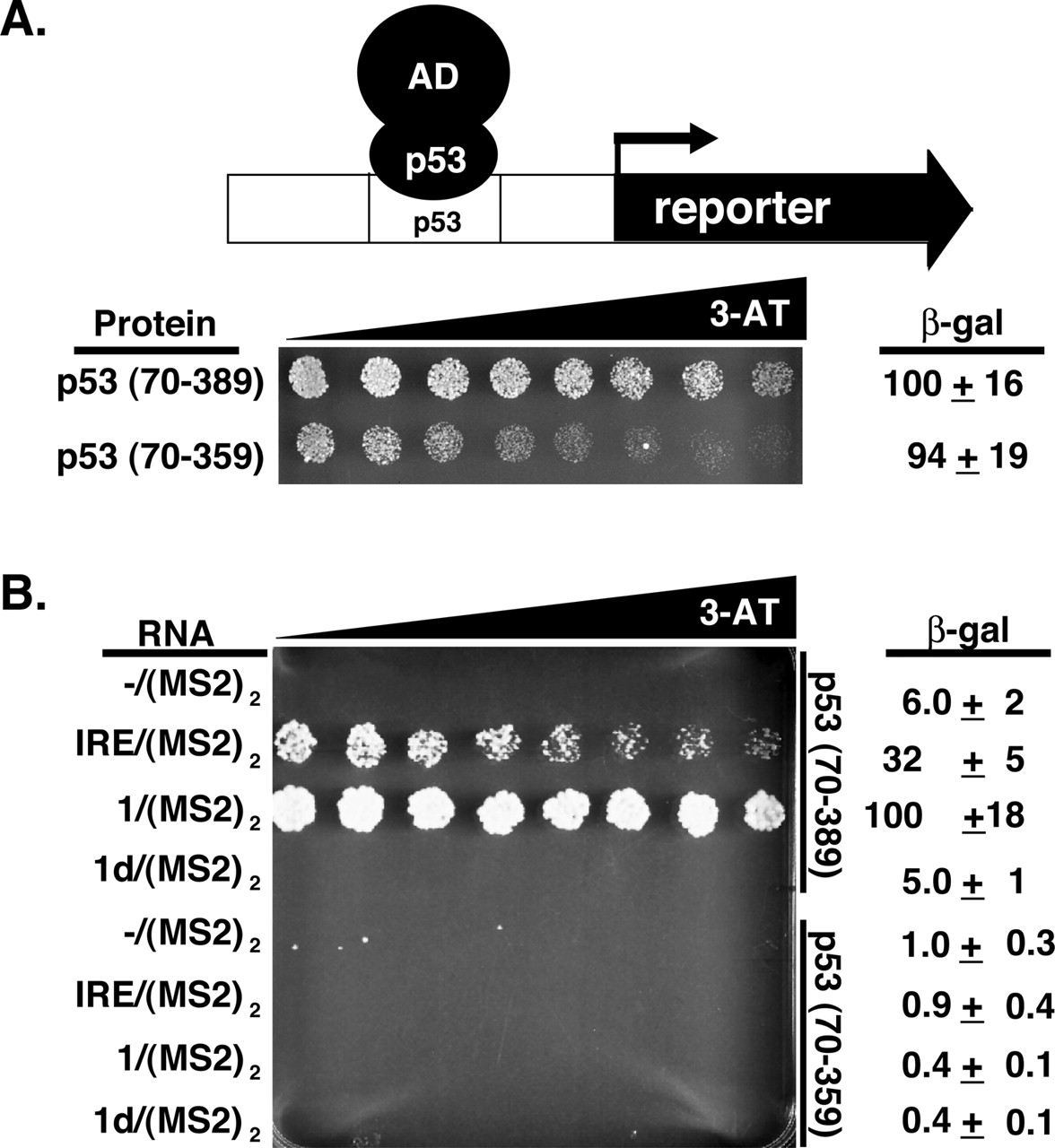
The p53 C-terminus is necessary for RNA recognition of IRE and RNA 1/(MS2)2 in the yeast three-hybrid system. (A) The p53 C-terminus is not necessary for DNA binding. (Top) Binding of GAL4AD/p53 to p53 recognition sites in DNA drives transcription of HIS3 and LacZ reporter genes. (Bottom left) Growth assay for HIS3 expression on selective medium containing a gradient of 0–5 mM 3-AT. (Bottom right) β-Galactosidase specific activities, normalized to the yeast strain expressing p53 amino acids 70–359 (signal set at 100 arbitrary units). Data reflect four independent transformants for each yeast strain. (B) Yeast three-hybrid system HIS3 and LacZ reporter gene assays for strains expressing (top) full-length p53 (70–389) or (bottom) the p53 C-terminal truncation (70–359). (Left) Growth assay for HIS3 expression on selective medium containing a gradient of 0–30 mM 3-AT. (Right) β-Galactosidase specific activities, normalized to the yeast strain expressing full-length p53 (amino acids 70–389) with RNA 1/(MS2)2. Data reflect four independent transformants for each yeast strain.




