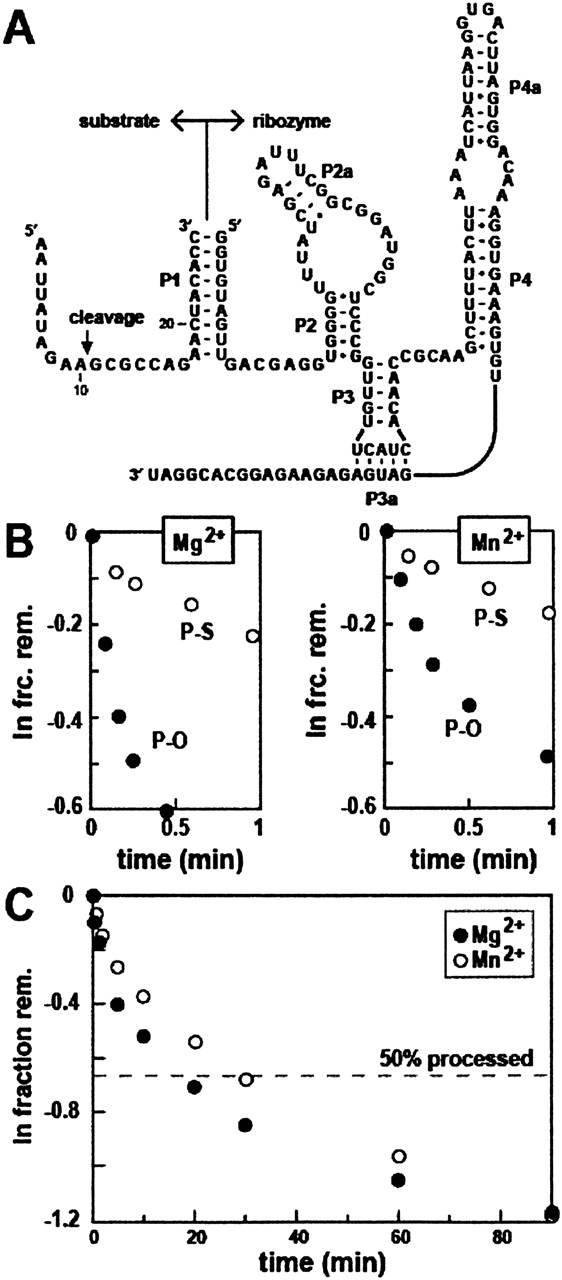
Absence of phosphorothioate effects at cleavage site non-bridging phosphate oxygens (NBPOs). (A) Secondary structure model of the bimolecular glmS ribozyme construct (based on B. cereus) used to assess effects of phosphorothioate modification at the cleavage site. (B) Time courses of ribozyme cleavage of unmodified (P–O, filled circles) and phosphorothioate-modified (P–S, open circles) substrates in the presence of 10 mM Mg2+ or 10 mM Mn2+, respectively. Assays were performed in 2 mM GlcN6P under single turnover conditions. Values were corrected for the fraction of substrate remaining uncleaved after exhaustive incubation. Approximate rate constants for initial phases of reactions in Mg2+ are 0.68 min−1 (P–O) and 0.20 min−1 (P–S); the corresponding values in Mn2+ are 0.40 min−1 (P–O) and 0.15 min−1 (P–S). (C) Extended time courses of ribozyme cleavage of phosphorothioate-modified substrate molecules in the presence of Mg2+ or Mn2+ as indicated. Experimental conditions were as described in B, except that values were not corrected for the fraction of substrate remaining uncleaved after exhaustive incubation.