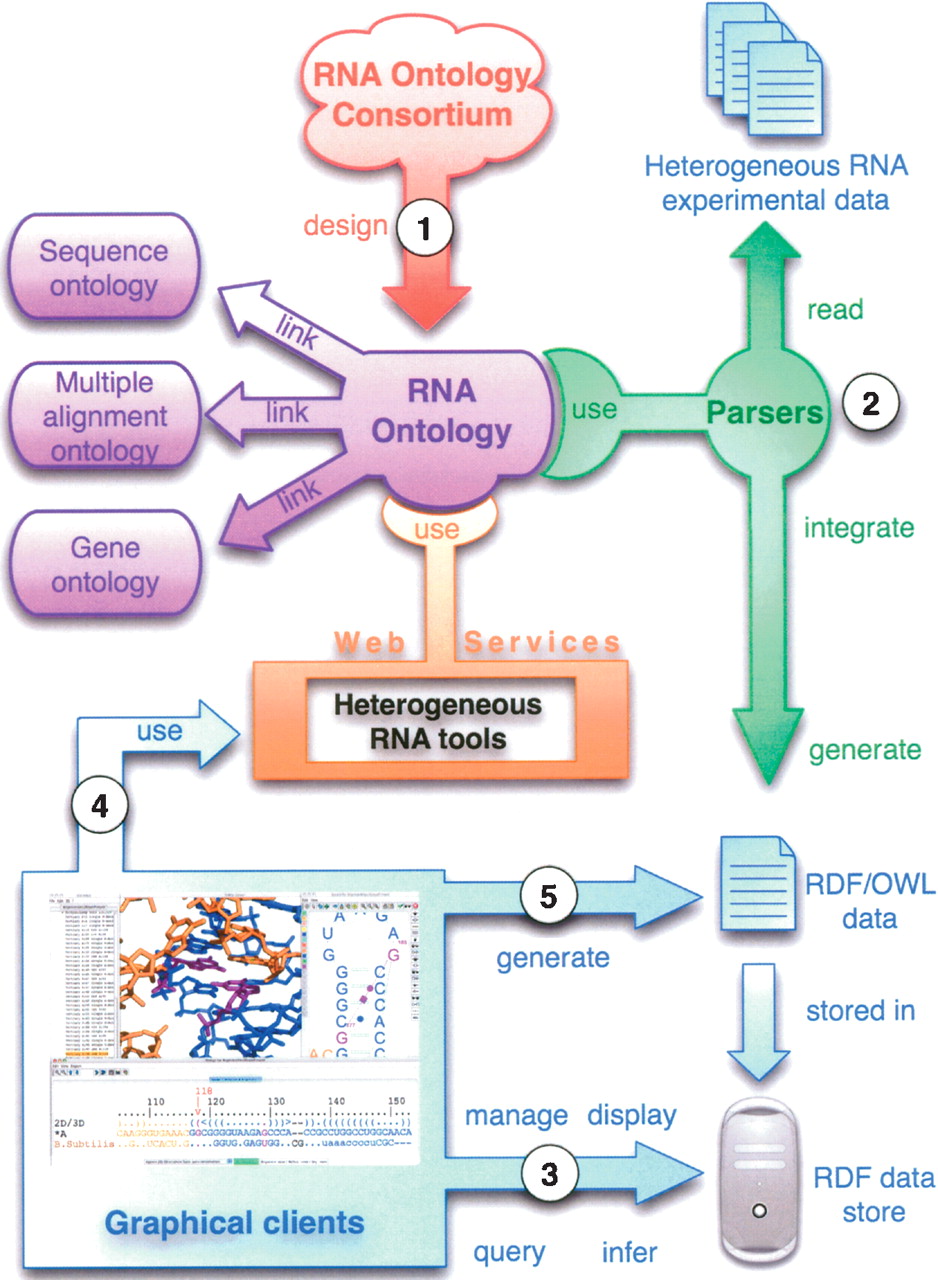
Ontologies formalize the structure of data by providing domain conceptualization to allow databases and software tools to interoperate. (1) The RNA Ontology (RO) is designed, written, and linked with related ontologies (Gene, Sequence, and Multiple Alignment Ontology). (2) The RO makes it possible to write parsers that can read heterogeneous experimental data and integrate these data to generate RDF/OWL data and make it available through RDF data stores. (3) New graphical clients can be written that use the RO to query RDF data store, manage and display data in useful ways, and infer new knowledge. (4) Graphical clients can also use the RO to access heterogeneous RNA tools to calculate new data (e.g., predict secondary or 3D structures, align sequences, find new genes). (5) New knowledge is added to RDF/OWL data and stored.