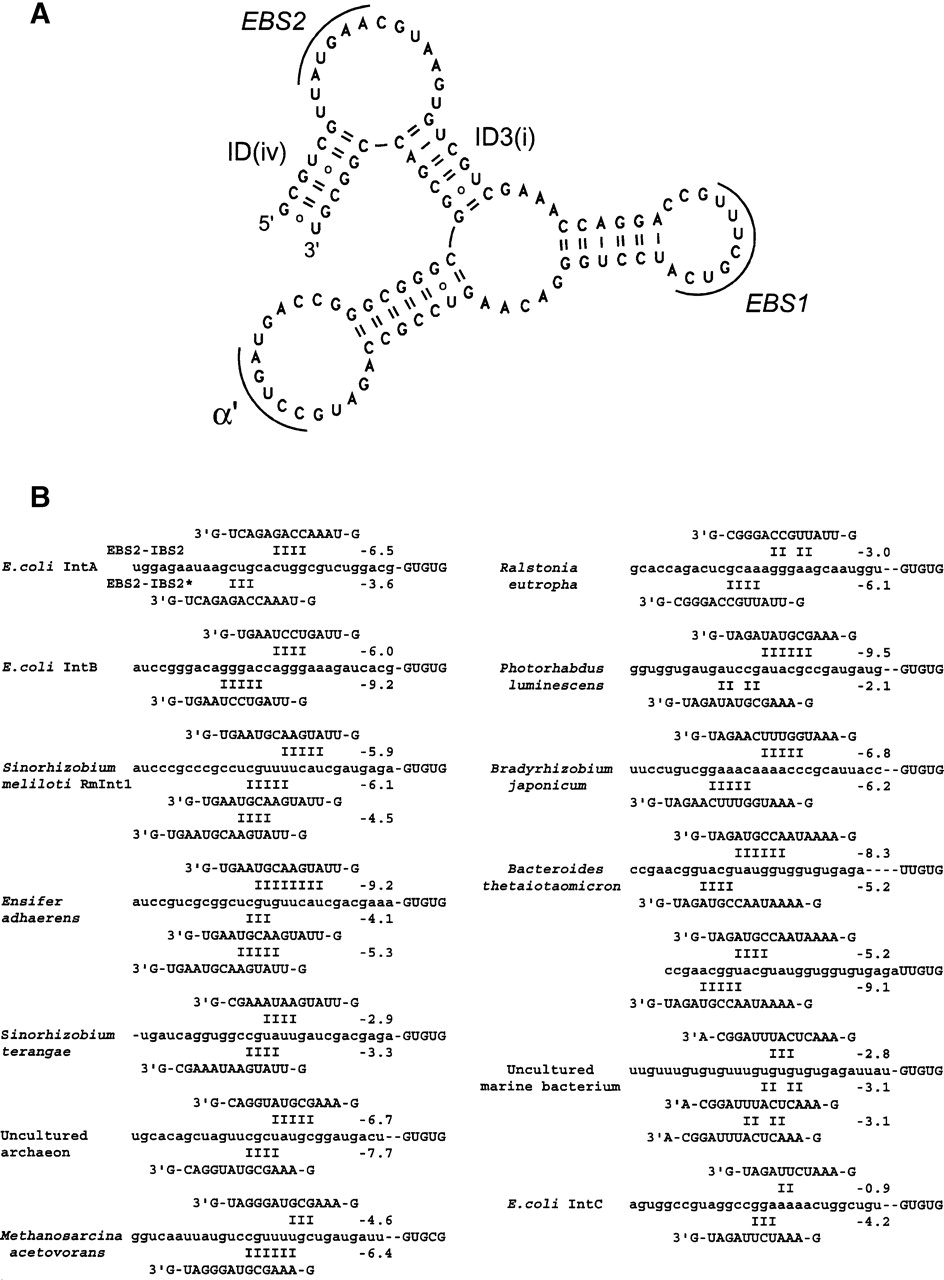
(A) A secondary structure model of the distal section of subdomain ID of the RmInt1 ribozyme. The proposed structure is slightly revised from Martínez-Abarca et al. (1998) based on comparison with other subgroup IIB3 sequences. (B) Potential for multiple pairings of the EBS2 loop with the 5′ exon in published members of the IIB3 subgroup. Exon sequences (followed by the first 5 nt of the intron) are in lowercase. For each entry, the EBS2–IBS2 pairing (defined from the near-constant relative register of the 5′ exon and EBS2 loop) is at the top and the proposed EBS2–IBS2* pairing(s) at the bottom. Alignment was on the last G of the 5′ branch of the ID(iv) helix, which is separated from the EBS2 loop by a dash (the first nucleotide of the ID3(i) helix [a G, with one exception] is also shown). Numbers are estimated free energies of base pairings at 1M NaCl and 37°C based on tables in Turner and Sugimoto (1988; pairings involving bulges were not taken into account). For the Bacteroides thetaiotaomicron intron, two possible registers of EBS2–IBS2 are shown. Published group II intron sequences that were found to be part of subgroup IIB3 (Toro 2003) with 100% bootstrap support based on phylogenetic analysis (see Ferat et al. 2003) of group II intron-encoded proteins using the PROTDIST program in PHYLIP (Phylogeny Inference Package v.3.6a2, University of Washington, Seattle) (accession numbers are followed by intron coordinates, when necessary, and reference[s]): E. coli IntA (AF512502, Dai and Zimmerly 2002b; Ferat et al. 1993); E. coli IntB (X77508, Ferat et al. 1994); Sinorhizobium meliloti RmInt1 (Y11597, Martínez-Abarca et al. 1998); Ensifer adhaerens (AY248839 and AY248840, Fernandez-Lopez et al. 2005); Sinorhizobium terangae (AY60890, Fernandez-Lopez et al. 2005); uncultured archaeon clone GZfos32G12 (AY714856, 10054–11891, Hallam et al. 2004); Methanosarcina acetivorans (NC_003552, 3708831–3706957, Galagan et al. 2002); Ralstonia eutropha (AY305378, 23468–25305, Schwartz et al. 2003); Photorhabdus luminescens (BX571862, 232816–234697, Duchaud et al. 2003); Bradyrhizobium japonicum (AF322013, 154084–155888, Gottfert et al. 2001); Bacteroides thetaiotaomicron (NC_004663, 3256655–3254752, Xu et al. 2003); uncultured marine bacterium (AY075117, Podar et al. 2002); E. coli IntC (AF512503, Ferat et al. 1993; Dai and Zimmerly 2002b).