


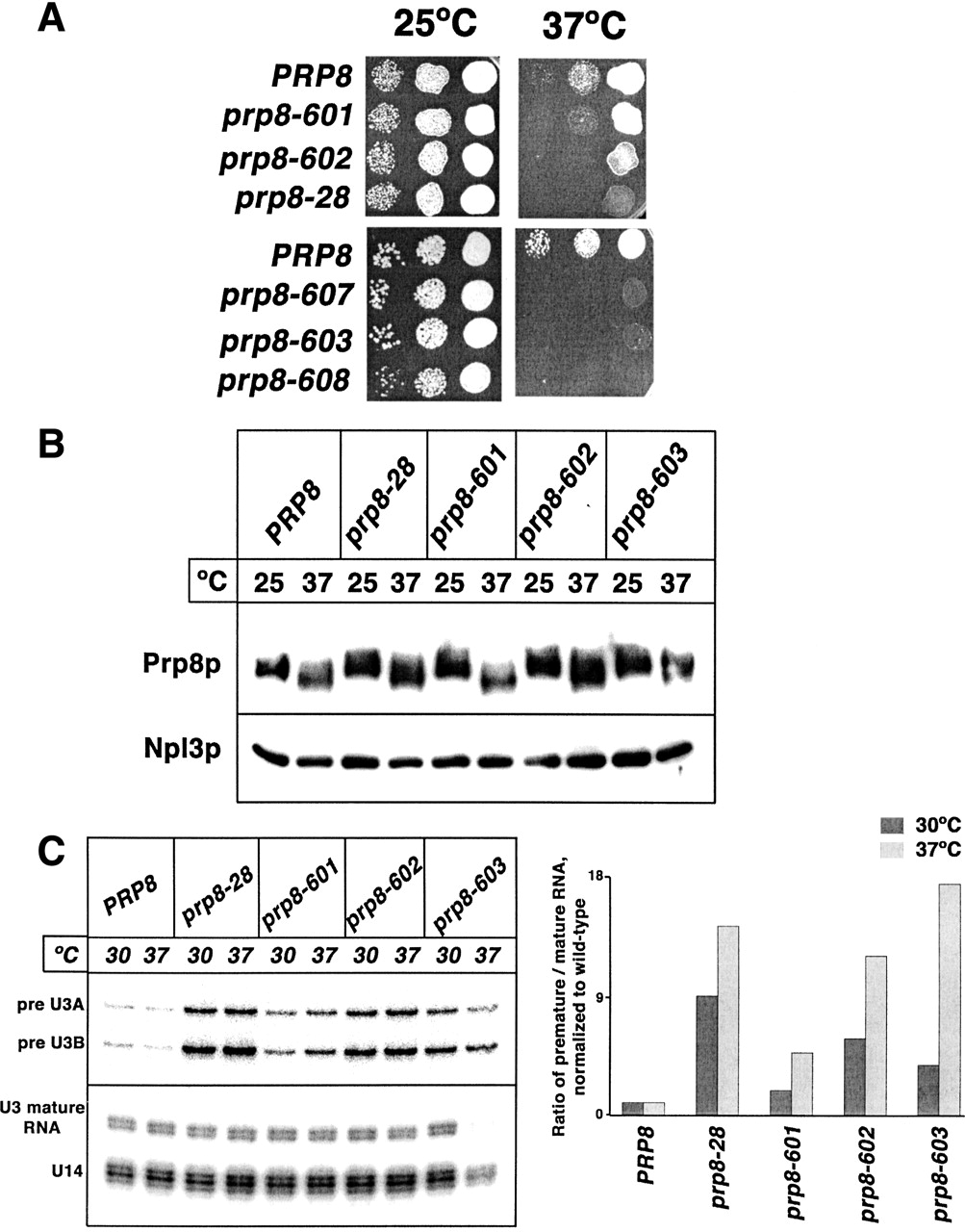
Alanine mutations in the noncanonical JAMM residues in PRP8 result in a temperature-sensitive growth phenotype. (A) The indicated strains were grown in complete media at 25°C up to mid-log phase, and serial dilutions of an equal number of cells were spotted onto YPD plates. Cells were grown at 25°C or 37°C and analyzed after 2 d. (B) Alanine mutations in the variant JAMM residues of the Prp8p Jab1/MPN domain do not significantly destabilize the protein at the restrictive temperature in vivo. The indicated strains were grown at 30°C and then shifted to 37°C for 4 h as indicated at the top of each lane. Equivalent amounts of whole-cell extract were resolved by 10% SDS-PAGE and immunoblotted with rabbit α-Prp8p antibodies (Collins and Guthrie 1999). As a loading control, the same blot was probed with α-Npl3p antibodies (Siebel and Guthrie 1996). The smeariness of the Prp8p is due to its susceptibility to endogenous proteases. The mutant Prp8 proteins do not differ significantly from the wild type. (C) Mutations in the Prp8p Jab1/MPN domain reduce splicing efficiency in vivo. Total yeast RNA was prepared from the indicated strains grown as described above in B. A 32P-radiolabeled oligonucleotide complementary to the U3 snoRNA was hybridized to 12.5 μg of total RNA and extended with M-MLV reverse transcriptase. The reaction products were resolved by denaturing gel electrophoresis and quantified with a PhosphorImager.




