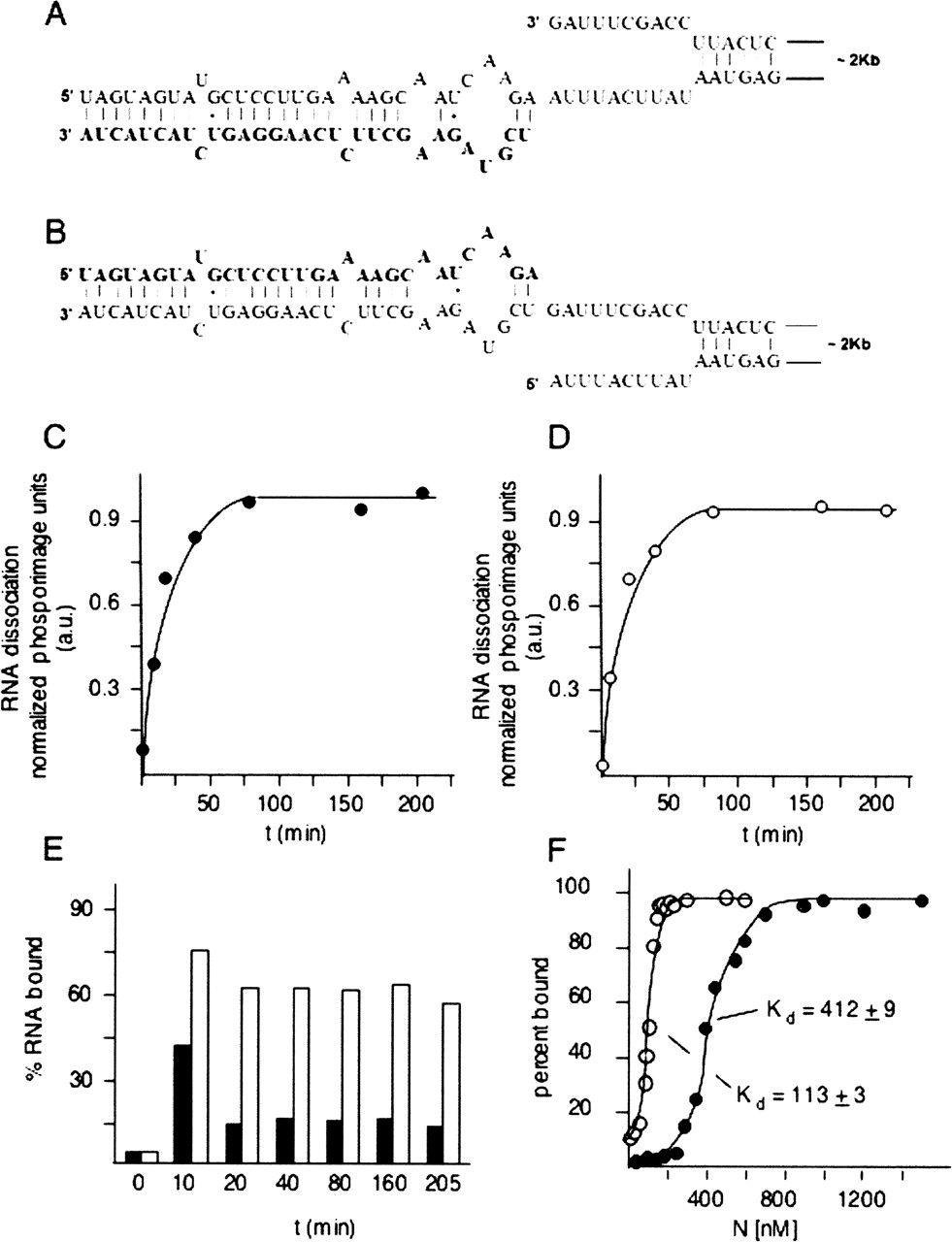
Dissociation of the viral RNA panhandle by N. A depicts a heteroduplex between a 31-nt-long, radioactively labeled RNA (shown in bold lettering) corresponding to the nucleotides from the 3′ end of the viral S segment, and a nearly full length S segment containing a deletion at the 3′ end. Deletion of the 3′ terminal nucleotides was necessary for efficient heteroduplex formation. B shows a corresponding heteroduplex in which a short labeled RNA corresponding to the 5′ end of the genome is annealed to a nearly full-length S segment harboring a deletion of the 5′ terminal nucleotides. As with the duplex shown in A, deletion of the terminal nucleotides from the S segment is necessary for efficient formation of the heteroduplex. C and D show the kinetics of dissociation of the radioactively labeled, short, terminal RNAs from the heteroduplex for the duplex in A and in B, respectively. Helix dissociation experiments were carried out as in Figure 3 using a N:RNA ratio = 1:1. RNA filter binding data using the two heteroduplexes are shown in E. Each heteroduplex was incubated with N for the indicated period of time, and protein-dependent retention of the small, labeled RNA corresponding to the 3′ end of the panhandle (▪) or the 5′ end of the panhandle (□) was determined. Panel F shows the results of RNA filter binding with increasing concentrations of N and either the 3′ terminal RNA (•) or the 5′ terminal RNA (○). Measured dissociation constants for both RNAs are also indicated.