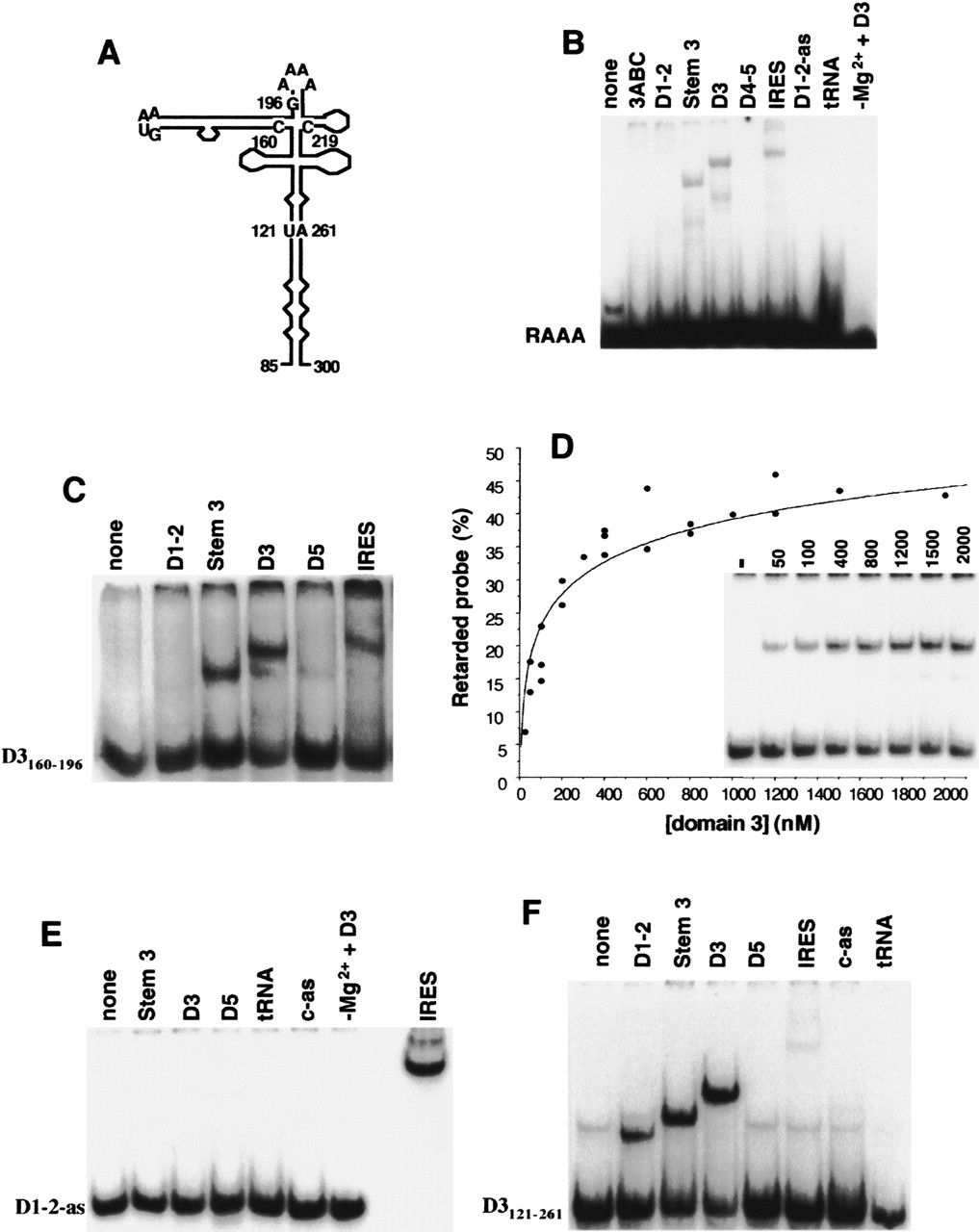
RNA–RNA interactions dependent on the apical region of the central domain. (A) Schematic representation of domain 3 with indication of the regions encoded in transcripts used as probes used in gel shift assays. (B) 5′-end-labeled RAAA synthetic oligoribonucleotide (50 nM) was incubated in binding buffer with the indicated sense RNAs (400 nM), antisense (as), or tRNA; the last lane was incubated without Mg+2. Transcript 3ABC corresponds to the apical region of domain 3, nt 151–227. Residues encompassing domains 1–2 and 4–5 are indicated in Figure1. RNA complexes were separated in native 6% acrylamide gels in TBM buffer. (C) Interaction of the FMDV GNRA hairpin is specific for the central domain. Gel shift analysis carried out with D3160–196 transcript (50 nM) as probe and the different unlabeled FMDV IRES domains (400 nM). (D) Titration curve of transcript D3160–196 interaction with the central domain. (E) Specificity of the interactions studied in gel shift assays. The antisense sequence of domain 1–2 (50 nM) was used as probe to interact with each of the indicated IRES sequences (400 nM) as indicated in panel B. The FMDV IRES was included as positive control. (F) Efficiency of RNA–RNA interaction within the central domain is increased by residues in the apical region. Gel shift performed with the enlarged version of the apical region D3121–261 (50 nM) and the indicated transcripts (400 nM). The control antisense (c-as) RNA is described in Materials and Methods.