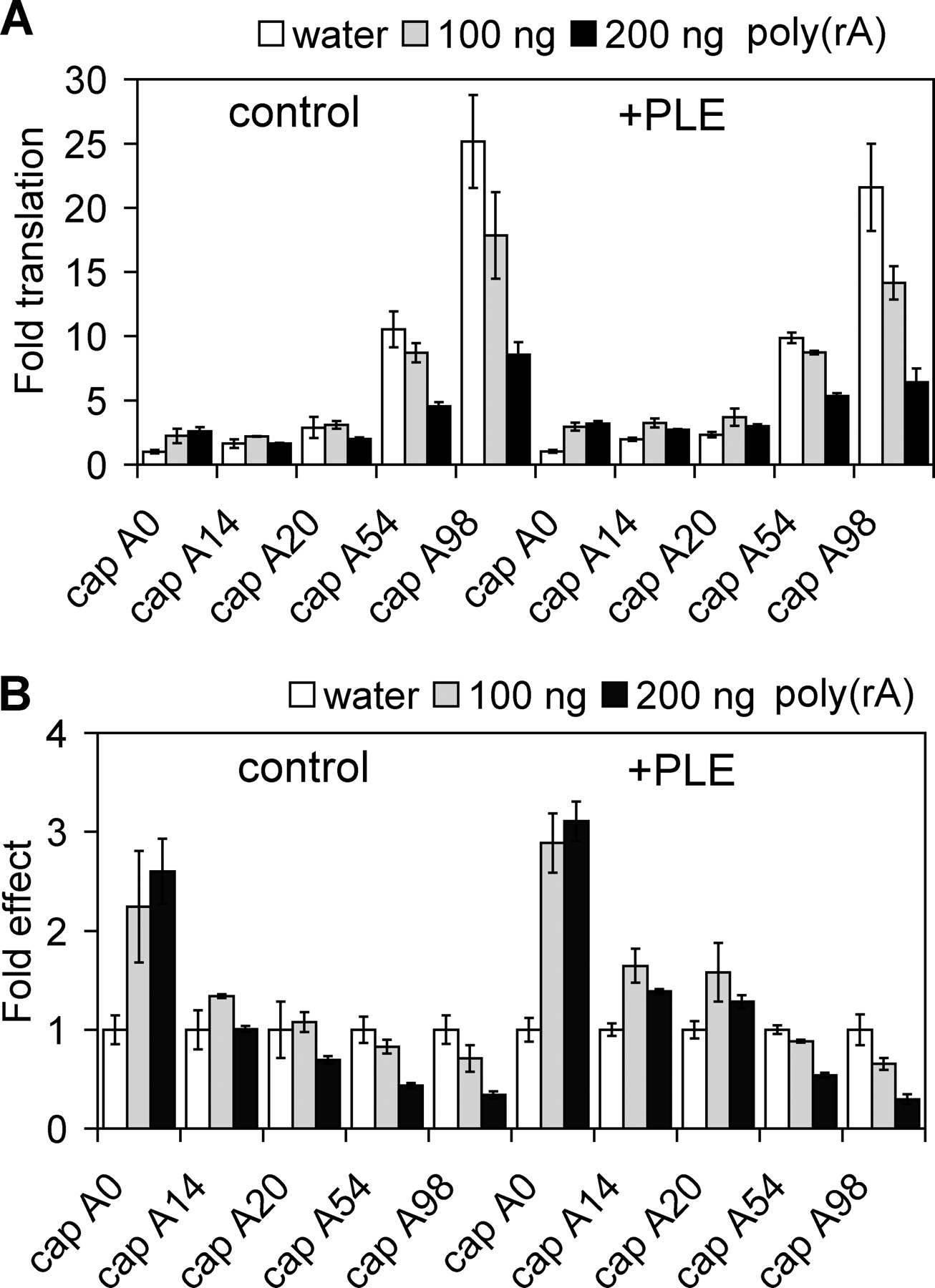
Impact of poly(rA) competition for poly(A)-binding proteins on the translation of PLE-containing mRNAs. In vitro translation was performed as in Figure 4 without (white bars) or with addition of 100 ng (gray bars) or 200 ng (black bars) of poly(rA) to each reaction. (A) The activity from capped control A0 luciferase mRNA with no added poly(rA) was arbitrarily set to 1, and the values shown are the fold difference in translation for each of the indicated mRNAs in the absence or presence of poly(rA). The bars represent the mean ± SD for triplicate determinations. (B) To determine the impact of poly(rA) on the translation of each individual mRNA, the values obtained in A with added poly(rA) were normalized to the value obtained for each buffer control. For comparison the buffer control for each mRNA was set to 1. The difference between control A20 versus +PLE A20 mRNA was statistically significant, with p < 0.01 by Student’s T-test.