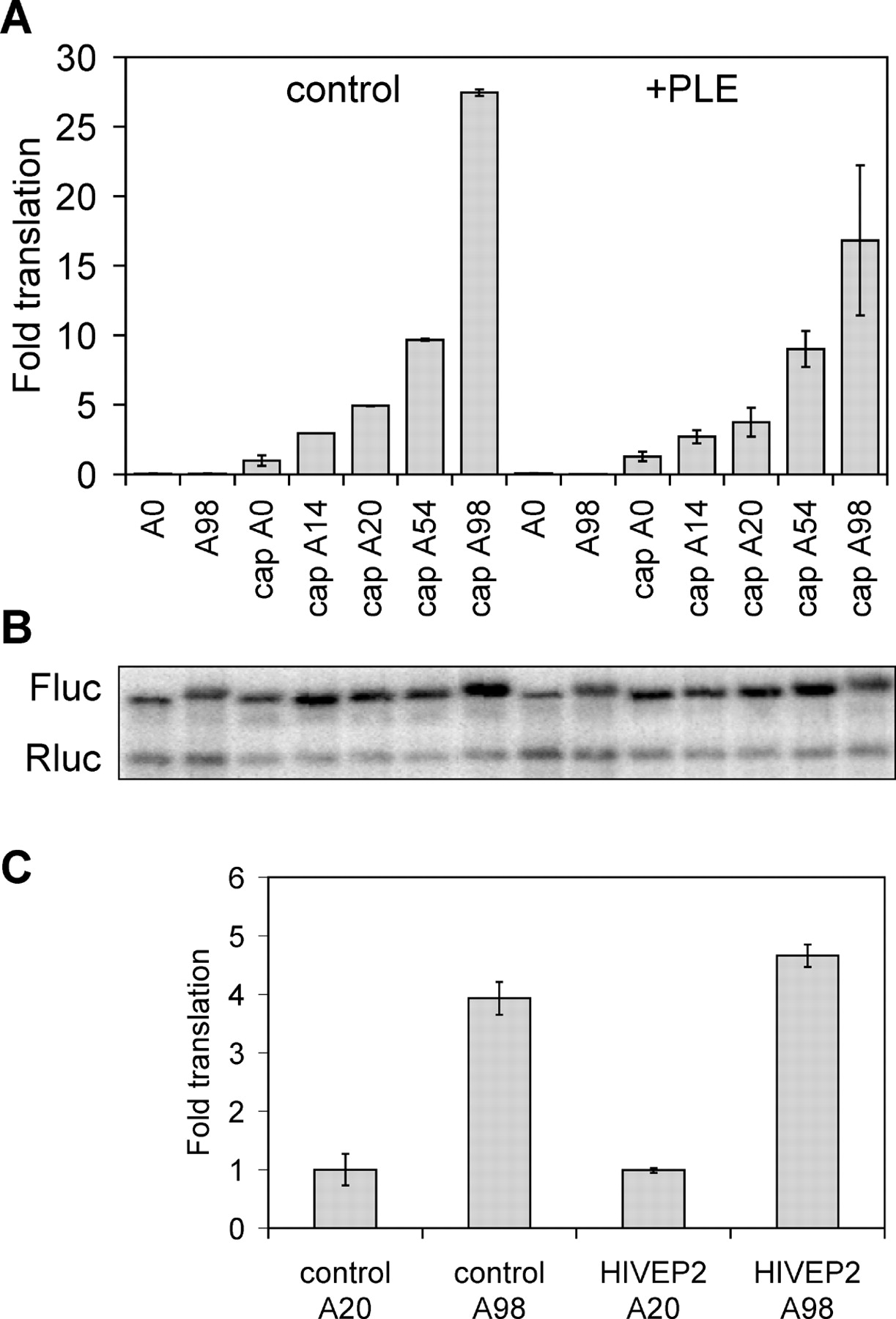
Impact of the PLE on translation in vitro. (A) The mRNAs shown in Table 1 were translated in a HeLa cytoplasmic extract for 1 h together with a control Renilla luciferase mRNA. A0 and A98 mRNA have 5′ ApppG, and mRNAs labeled “cap” have 5′ 7mGpppG. The fold translation shown in the upper panel represents firefly luciferase activity normalized to Renilla luciferase activity, and each bar consists of the mean ± SD for triplicate determinations. To facilitate comparison between the individual mRNAs, the value for capped A0 mRNA was arbitrarily set to 1. (B) RNA extracted from each pooled set of reactions was analyzed by Northern blot as in Figure 1 using a mixed probe for firefly (Fluc) and Renilla (Rluc) luciferase. (C) The PLE identified in HIV-EP2 mRNA (HIVEP2) was inserted into A20 or A98 firefly luciferase mRNA in place of PLE B from albumin mRNA. These capped mRNAs were translated in triplicate and compared to translation of control A20 and A98 mRNA together with Renilla luciferase control. In this experiment the translation of capped A20 mRNA normalized to translation of Renilla luciferase mRNA was arbitrarily set to 1 and results with the other mRNAs were normalized to this. The bars represent the mean ± SD for triplicate determinations.