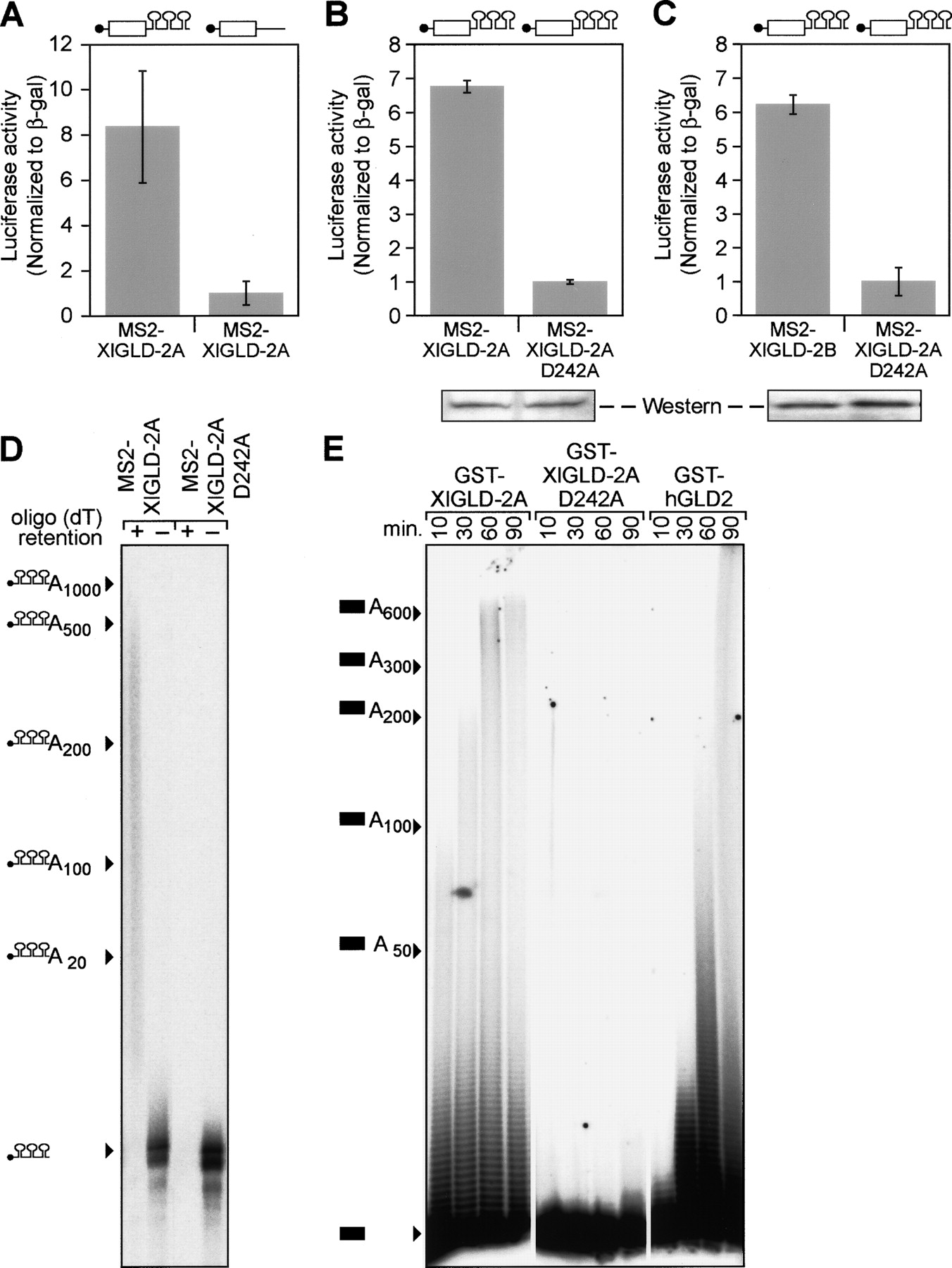
Vertebrate GLD2 homologs are poly(A) polymerases in vivo and in vitro. (A) Translational stimulation in vivo. Oocytes containing MS2/XlGLD-2A protein increase the expression of a luciferase reporter mRNA that contains MS2 binding sites in its 3′UTR (left), but does not increase expression with an mRNA reporter that lacks MS2 binding sites (right). Luciferase activity is normalized to that of β-galactosidase, generated from a coinjected mRNA that lacks MS2 binding sites. (B) An active site mutation abolishes translational stimulation. Oocytes containing MS2-XlGLD-2A protein with an active site mutation, D242A, do not stimulate translation of the luciferase reporter mRNA that contains MS2 sites. The wild-type protein was used as a control. Western blotting with α-HA antibodies demonstrates the wild-type and mutant proteins are comparable in abundance. (C) XlGLD-2B is active in vivo. Oocytes containing MS2-XlGLD-2B protein increase the expression of a luciferase reporter mRNA that contains MS2 binding sites in its 3′UTR (left). The point mutant protein was used as a control and is inactive. Western blotting with α~HA antibodies demonstrated the wild-type and mutant proteins are comparable in abundance (shown below the histogram). (D) Poly-adenylation in vivo. A 32P-labeled RNA containing three MS2 sites was injected into oocytes expressing either MS2-XlGLD-2 or MS2-XlGLD-2A (D242A). Oocytes were collected after 16 h, and the RNA was extracted and fractionated using biotinylated oligo(dT). + indicates RNAs that bound the resin; −, RNAs that did not bind the resin. Positions of RNAs carrying various lengths of poly(A) (determined by using markers) are shown to the left. (E) Poly-adenylation in vitro. Recombinant GST-XlGLD-2A, GST-XlGLD-2A(D242A), and GST-hGLD2 proteins, purified from Escherichia coli, were incubated at 24°C with L1 RNA (see Materials and Methods) and a mixture of all four ribonucleoside triphosphates at 1 mM. Samples were collected at the indicated time points and analyzed by denaturing gel electrophoresis. Positions of RNAs carrying various lengths of poly(A) (determined by using markers) are shown to the left.